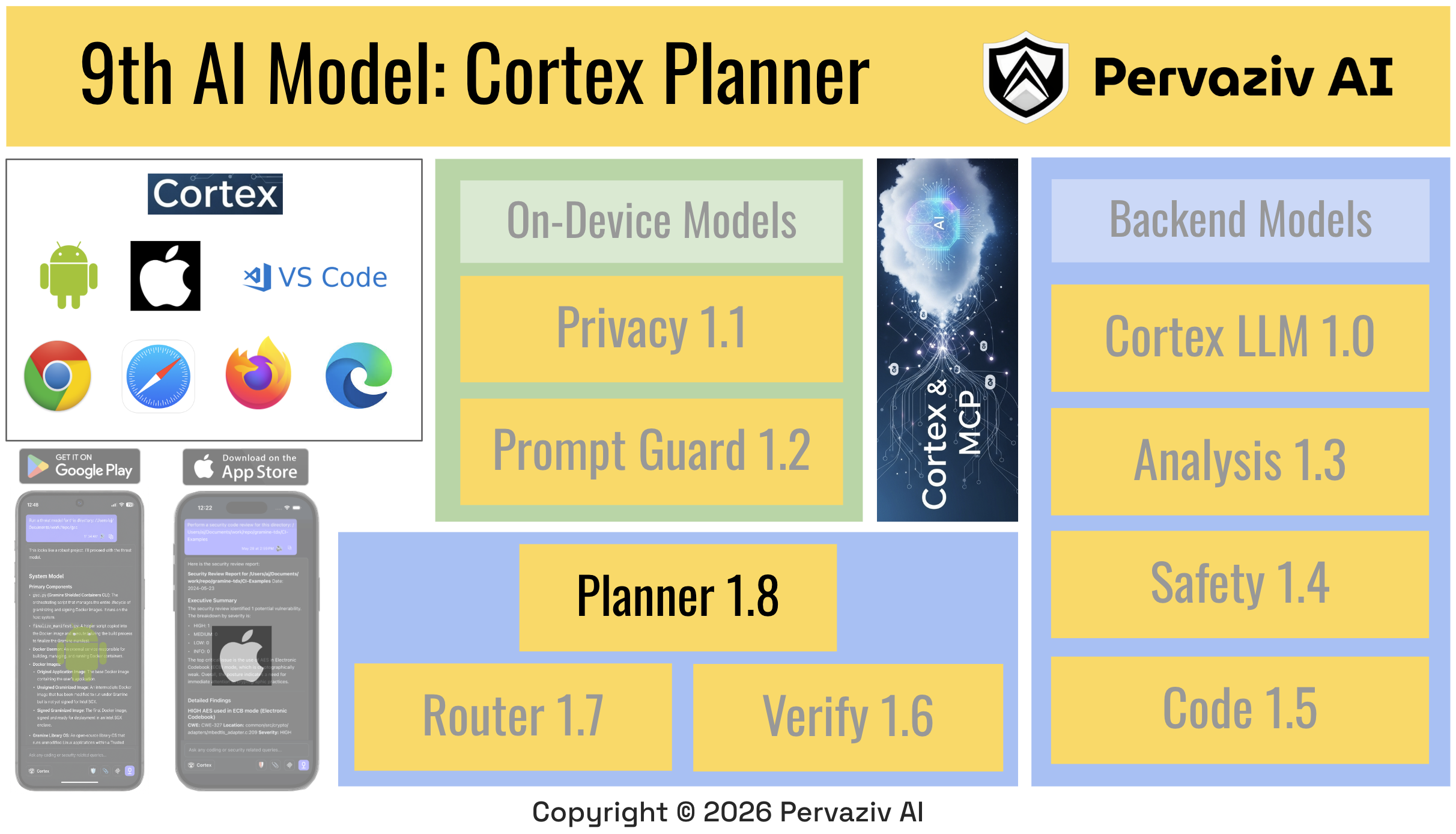

New planning intelligence turns complex engineering requests into execution plans spanning implementation, testing, security review, integration, and validation
SAN FRANCISCO , CA, UNITED STATES, August 21, 2026 /EINPresswire.com/ — Pervaziv AI today announced Cortex Planner, the ninth specialized model in the Cortex AI Model Ensemble, adding a dedicated planning layer for coordinated AI assisted software delivery.
Cortex Planner is designed to transform a development objective into a structured execution plan. It interprets the requested outcome, available context, permitted actions, dependencies, and validation requirements, then organizes the work into clear stages that can involve analysis, implementation, testing, security review, integration, and verification.
The release builds on Pervaziv AI’s expanding model ensemble and follows Cortex Router, the eighth specialized model introduced to understand developer intent and direct requests toward the appropriate capability or workflow. Router helps determine where work should go. Planner defines what needs to happen next and how the work should come together.
Together, the capabilities move Cortex AI Model Ensemble beyond isolated AI interactions toward a more deliberate model for software delivery. Instead of treating a broad engineering request as one opaque action, Cortex can represent the work as an organized progression with dependencies, checkpoints, acceptance criteria, and validation considered from the beginning.
“AI becomes materially more useful when it can do more than answer the next question,” said Anoop Jaishankar, Founder and CEO of Pervaziv AI. “It must understand outcomes, map work, respect dependencies and boundaries, and know what evidence proves the job is complete. Cortex Planner gives the Ensemble a plan before execution begins, so specialized intelligence can contribute with purpose and teams can see how the work is expected to reach a validated result.”
Jaishankar continued, “The next phase of Enterprise AI will be measured by whether complex work can be organized responsibly, not simply by how quickly a model can produce code. Planning, permissions, specialist collaboration, validation, and human judgment have to work together. Cortex Planner brings those elements closer to the beginning of the workflow, where they can shape execution rather than inspect it only after the fact.”
## From Intelligent Routing to Planned Execution
——————————————————————-
Pervaziv AI introduced the Cortex AI Model Ensemble to bring specialized intelligence to different responsibilities across secure software development. The architecture was designed around the idea that privacy, prompt protection, security analysis, safety decisions, coding, validation, and workflow coordination benefit from capabilities with defined roles rather than one undifferentiated model.
Cortex Router extended that architecture by becoming an intelligent entry point for the Ensemble. It evaluates the intent, scope, and sensitivity of a request and helps identify the appropriate path through Cortex.
Cortex Planner adds the next layer.
Once the direction of the work is understood, Planner can organize how the objective should be approached. It can distinguish discovery from execution, separate work that can proceed independently from work that depends on earlier results, and identify where testing, review, integration, or validation should occur.
That distinction matters because real engineering work rarely maps to a single prompt and a single response.
A request to add a product capability can require understanding an existing implementation, identifying the components affected, making changes in more than one area, adding tests, reviewing documentation, checking security implications, integrating multiple outputs, and validating the result against the original requirement.
A defect can require reproduction, diagnosis, code changes, regression tests, and confirmation that surrounding behavior remains intact.
A security remediation can require root cause analysis, a focused fix, tests for the vulnerable and corrected behavior, review of related risk, and evidence that the issue was addressed without introducing regressions.
Cortex Planner is designed to make those paths explicit before the work is treated as complete.
## A More Deliberate Cortex AI Model Ensemble
—————————————————————-
The introduction of Cortex Planner advances Cortex AI Model Ensemble from task handoff toward intelligent orchestration.
Planner can translate a broad request into stages with defined purposes and expected outcomes. When more context is needed, discovery can be represented as part of the plan rather than hidden inside execution. When several activities can move forward independently, they can be separated into parallel workstreams. When outputs need to converge, integration can be made an explicit step. When quality or security requirements matter, validation can be planned before changes are considered complete.
For example, a product change that touches an application interface, backend service, tests, and documentation does not have to be represented as one large operation. The plan can separate those concerns, identify dependencies, coordinate the work, and bring the results together for validation against the original objective.
For security sensitive work, the same approach can help organize remediation alongside regression testing, security review, integration, and verification. The emphasis is not simply generating a proposed patch. It is creating a clearer path from identified risk to a result that can be reviewed and supported by evidence.
This approach can help teams gain:
Clearer decomposition of complex engineering requests
Better coordination across specialized AI capabilities
More intentional sequencing of analysis, implementation, testing, review, integration, and validation
Greater visibility into dependencies and completion criteria
A stronger foundation for governed AI assisted software delivery
The result is an Ensemble designed to help answer not only “what did the AI produce?” but also “what work was required, what depended on what, what was checked, and what remains before the objective is complete?”
## Planning With Boundaries Built In
—————————————————-
As AI systems take on larger software tasks, planning becomes a governance problem as well as an engineering problem.
Cortex Planner is designed to operate within trusted context and defined permissions. It does not treat missing information as permission to act. When the available context is insufficient, the plan can include discovery before execution. When actions require constraints or approvals, those requirements can remain visible in the progression of work. When activities could conflict, Planner can organize a safer sequence instead of assuming they should occur at the same time.
Organizations also need to consider which systems are involved, which data can be used, what actions are authorized, which checks are required, where human review belongs, and what evidence is needed before a change can advance.
By introducing planning as a specialized capability, Pervaziv AI is extending its Enterprise AI Control Layer into the structure of the work itself.
The goal is not unrestricted autonomy. The goal is useful coordination inside clear operating boundaries.
## Designed for Specialist Collaboration
——————————————————
Cortex Planner reflects the broader design principle behind the Cortex AI Model Ensemble: different engineering responsibilities call for different forms of intelligence.
The Ensemble has grown from six specialized models to nine as Pervaziv AI has added focused capabilities for validation, routing, and now planning.
The nine model lineup includes Cortex LLM, Cortex Privacy, Cortex Prompt Guard, Cortex Analysis, Cortex Safety, Cortex Code, Cortex Verify, Cortex Router, and Cortex Planner.
Privacy intelligence can help identify sensitive context. Prompt protection can evaluate instruction risk. Analysis can support deeper investigation. Safety can help enforce workflow boundaries. Coding intelligence can support implementation. Verify can evaluate whether proposed changes satisfy intended requirements and validation expectations. Router can determine the appropriate path for a request. Planner can organize how those capabilities and related engineering activities should work toward a common outcome.
This makes Planner less like another destination in a model catalog and more like a coordination layer between intent and execution.
A complex task can require several specialist contributions at different points. Planner helps define why each contribution is needed, when it should occur, what it depends on, and how its result contributes to completion.
## Making Validation Part of the Plan
—————————————————-
One of the central ideas behind Cortex Planner is that validation should not appear only at the end of an AI workflow.
Effective software delivery starts with a clear definition of what success means.
Cortex Planner can incorporate acceptance criteria and validation requirements into the plan from the beginning. The target is not simply that code changed, files were modified, or a response was produced. The target is that the requested outcome was addressed, important constraints were preserved, relevant checks were performed, and the result can be evaluated against the original objective.
That approach creates a stronger connection between planning and Cortex Verify.
Planner can define what needs to be true for a task to be considered complete. Verify can contribute focused validation reasoning around whether the resulting change, supporting tests, project expectations, and available evidence align with that definition.
It can also create clearer collaboration across developers, security teams, engineering leaders, and AI capabilities. A plan that makes acceptance criteria visible can help participants understand not only what is being changed, but what must be demonstrated before the work should advance.
## Parallel Work Without Losing the Outcome
—————————————————————
Complex development often contains work that can happen independently.
Analysis of one component may not need to block test design for another. Documentation preparation may proceed while implementation is underway. Multiple code areas may be updated in parallel as long as their integration point is understood.
Cortex Planner can identify opportunities for independent work while preserving the dependencies that matter.
This is an important distinction for AI orchestration. Parallelism alone is not the objective. Uncoordinated parallel work can create duplication, incompatible changes, missed assumptions, and difficult integration.
The value comes from organizing independent activities around a shared objective and then bringing them together at the appropriate point.
Planner provides a structure for that coordination. It can represent parallel branches, define what each branch is expected to produce, and make convergence part of the plan instead of leaving integration to chance.
## Human Control Where It Matters
————————————————-
Pervaziv AI’s approach to agentic engineering is built around the idea that greater AI capability should not require organizations to surrender meaningful control.
Some engineering activities can be performed within established permissions and workflow boundaries. Other actions can have consequences outside the immediate development context and may require explicit human confirmation.
Cortex Planner can preserve those confirmation points as part of the plan.
Rather than assuming authority to proceed through every stage, the workflow can identify where a person should review, approve, or make a consequential decision. This makes human involvement part of the execution design rather than an exception added after automation has already acted.
For enterprises, that distinction can be important when AI workflows touch production systems, external services, sensitive information, security decisions, or other operationally significant actions.
The objective is practical enterprise AI: capable enough to organize complex work, transparent enough to understand the path, constrained enough to respect permissions, and structured enough to keep people accountable for decisions that matter.
## From AI Assistance to Coordinated Delivery
————————————————————–
The introduction of Cortex Planner also reflects a broader change in AI assisted development.
Early coding assistants focused heavily on suggestions, completions, explanations, and individual code generation tasks. Newer agentic systems can work across repositories, use tools, execute tests, inspect results, and continue across multiple steps.
As capability expands, the orchestration problem becomes more important.
A system that can take more actions also needs a better understanding of sequence, dependencies, scope, stopping conditions, evidence, and escalation. The quality of the final result depends not only on the intelligence used at each step, but on how the steps fit together.
Cortex Planner is designed around that transition.
It provides a planning layer that can connect a developer request to a coordinated path through Cortex AI Model Ensemble. That path can bring together specialist AI capabilities, engineering activities, validation expectations, permissions, and human checkpoints according to the needs of the task.
## Advancing the Enterprise AI Control Layer
————————————————————-
Cortex Planner 1.8 extends Pervaziv AI’s broader vision for Cortex as an Enterprise AI Control Layer.
That vision is based on the belief that enterprise AI requires more than model access. Organizations need mechanisms for context, routing, permissions, security, privacy, validation, integration, and human oversight around the intelligence being used.
The Cortex AI Model Ensemble supplies specialized intelligence for defined responsibilities. Cortex Router helps translate developer intent into the appropriate path. Cortex Planner now helps translate that path into an organized sequence of work.
Together, those layers create a clearer progression from request to execution to evidence.
This also advances Pervaziv AI’s model independence strategy. Specialized roles allow individual models and capabilities to evolve without forcing every workflow to depend on one general system. Planning and routing can coordinate those responsibilities while the wider control layer governs how context, tools, permissions, and validation are applied.
Enterprises will need to know not only which model generated an answer, but why a capability was selected, what work was planned, what actions were permitted, how results were combined, what checks were performed, and where humans remained involved.
Cortex Planner helps make that operating model more explicit.
## The Ninth Model and the Next Stage of the Ensemble
—————————————————————————-
Cortex Planner 1.8 expands the Cortex AI Model Ensemble to nine specialized models and implements a dedicated planning capability.
The release follows a progression from specialized intelligence, to validation, to routing, and now to planning. Each step adds another layer required for AI to participate more effectively in real engineering work.
For developers, Planner can provide a clearer path through complex requests.
For security teams, it can help ensure review and validation are represented as part of the work rather than added after implementation.
For engineering leaders, it can provide greater visibility into how AI assisted activities are organized around dependencies, permissions, acceptance criteria, and completion.
For organizations evaluating agentic AI, it represents a move toward systems designed not merely to act, but to coordinate action within a governed process.
“The most important AI workflow is not the one that performs the most steps,” Jaishankar said. “It is the one that knows why each step exists, what has to happen before the next one, and what must be proven at the end. That is the standard we are building toward with Cortex Planner and Cortex AI Model Ensemble.”
Cortex Planner 1.8 brings Pervaziv AI closer to an intelligent Ensemble where every request can have a clearer path forward, every specialist contribution can serve a defined purpose, and every outcome can be designed to be understood, validated, and trusted.
## Availability
——————
Cortex Planner 1.8 is the ninth specialized model in the Cortex AI Model Ensemble and is designed to strengthen planning and orchestration within Cortex. Additional information about Cortex, the AI Model Ensemble, and Pervaziv AI’s secure enterprise AI capabilities is available through the company’s website and newsroom.
## About Pervaziv AI
—————————-
Pervaziv AI develops Enterprise AI and cybersecurity technology for modern software teams. Cortex brings together AI assisted coding, security, privacy, connected enterprise context, cloud intelligence, specialized models, agents, validation, and governance across developer workflows. Pervaziv AI’s broader platform is designed to help organizations build, secure, and deliver software with greater speed, visibility, and control.
Pervaziv AI
Pervaziv AI
email us here
Visit us on social media:
LinkedIn
Instagram
YouTube
X
Other
Legal Disclaimer:
EIN Presswire provides this news content “as is” without warranty of any kind. We do not accept any responsibility or liability
for the accuracy, content, images, videos, licenses, completeness, legality, or reliability of the information contained in this
article. If you have any complaints or copyright issues related to this article, kindly contact the author above.

Media gallery