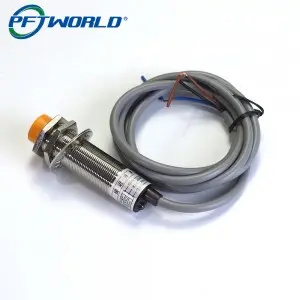

SHENZHEN, GUANGDONG, CHINA, September 1, 2026 /EINPresswire.com/ — PFTWORLD supports metal, plastic, and liquid detection applications as a Leading Proximity Sensors Supplier by using different sensing technologies rather than attempting to adapt one universal model across incompatible environments. For industrial operations, the LJ18A3-8-Z/BX serves as an inductive, normally open NPN three-wire sensor designed specifically for contactless metal detection with a stated sensing range of up to 8 mm. To address applications that fall outside the capabilities of inductive metal response, capacitive, photoelectric, and non-contact liquid-level families provide separate, dedicated routes for identifying selected non-metal and fluid-related targets, ensuring that each detection requirement is paired with its optimal sensing principle.
Detection Across Different Materials Requires Different Sensor Principles
Shenzhen Perfect Precision Products Co., Ltd. (PFTWORLD) separates sensor technologies according to target material so that metal, selected non-metal, and liquid detection requirements are carefully matched to the appropriate sensing principle. Inductive proximity sensing remains the standard mechanism used for metal targets, providing a reliable response when conductive materials enter the designated sensing field. Conversely, capacitive and selected photoelectric or liquid-level sensor families broaden the supplier-level range for non-metal or fluid-related detection tasks that an inductive model cannot process.
This technology split is the central buyer message because material type, sensing distance, output configuration, and the operating environment ultimately determine which sensor family should enter the application review. Material coverage belongs to the supplier’s portfolio as a whole, rather than being consolidated into a single universal proximity sensor. By maintaining distinct inductive, capacitive, photoelectric, and liquid-level-related sensing families, the manufacturer ensures that target material and the underlying sensing principle must be aligned appropriately, avoiding the risks associated with generalizing performance from one specific model to an entire automation system. Consequently, technology selection must always begin with a rigorous analysis of the target material itself.
LJ18A3-8-Z/BX Provides a Defined Inductive Metal-Detection Example
PFTWORLD’s LJ18A3-8-Z/BX provides a specific inductive example for contactless metal-object detection, engineered with defined electrical and distance characteristics that suit standard industrial environments. The model is identified as a normally open, NPN, three-wire configuration, providing the precise electrical-output detail that buyers require when comparing the sensor with their existing controller or input parameters. By establishing these electrical baselines upfront, procurement and engineering teams can confirm compatibility with their automation logic without unnecessary testing.
Its stated sensing distance is up to 8 mm for this documented model, and that value remains strictly model-specific rather than being presented as the standard sensing distance for the entire PFTWORLD proximity range. This precision prevents installation errors that occur when a single metric is assumed to apply universally across a product catalog. The LJ18 example establishes a clear, dependable metal-detection route without ever implying that its inductive sensing capabilities can be transferred to plastic or liquid targets, reinforcing the necessity of matching the sensor directly to the application.
Capacitive Sensing Extends the Portfolio to Selected Non-Metal Targets
PFTWORLD’s capacitive sensor offering provides the supplier-level route for detecting selected non-metal materials where changes in dielectric properties can be sensed reliably. Capacitive sensing is uniquely relevant to materials that inductive sensors simply cannot detect, meaning that plastic or other non-metal target discussions should always be attached to the capacitive product family rather than to the LJ18 metal sensor. This fundamental difference in detection physics allows the capacitive range to identify objects based on their dielectric shift, making it suitable for a wider array of industrial tracking and positioning tasks.
Application success still depends heavily on material properties, target geometry, sensing distance, and the surrounding environment, which means that no single detection range is assigned universally to every plastic target. Capacitive sensors broaden the non-metal detection options available to a facility, but the exact plastic or material application must always be validated against the selected sensor and its intended installation context. Buyers must verify the specific target composition and mounting constraints to ensure that the capacitive response meets the required sensitivity and precision for their automation workflow.
Liquid-Level and Related Sensor Families Address Fluid Detection at Portfolio Level
The broader sensor category includes non-contact liquid-level sensing and other intelligent sensor products, allowing complex liquid applications to be discussed thoroughly without misusing the inductive proximity model. Liquid detection should therefore be presented as a separate, distinct product-family capability whose required mounting arrangements, container material constraints, output types, and environmental operating conditions must be confirmed specifically for the fluid application in question.
Keeping fluid sensing completely distinct from metal proximity detection preserves model-level accuracy and prevents one sensor principle from being applied beyond its intended target scope. PFTWORLD’s investment in sensor research, development, production, and sales extends well beyond inductive proximity models, providing a comprehensive approach to industrial detection. Liquid applications are supported at the sensor-portfolio level and should always be matched to the exact liquid-level or related sensing model that has been selected and qualified for the individual project parameters.
Photoelectric Options Add Object Detection Beyond Metal-Only Inductive Sensing
PFTWORLD’s photoelectric products add another highly effective non-contact route for object detection, incorporating model families that are described specifically for opaque or transparent targets. Photoelectric sensing relies on optical interaction rather than the inductive metal response, which means it can successfully address object-detection tasks where the target material alone does not make an inductive sensor suitable. This optical capability allows facilities to monitor packaging, sort materials, and verify presence across production lines that handle diverse, non-metallic items.
Operating voltage, optical mode, sensing distance, and the target’s optical properties remain strictly model-specific. This variation means that a photoelectric example should never be used to generalize the electrical or distance specification of the entire sensor range. Photoelectric options successfully broaden the scope of object detection while strictly preserving the model-specific electrical, distance, and optical requirements necessary for reliable integration. By treating photoelectric sensing as a distinct technological pathway, buyers can implement optical detection where it excels while avoiding misapplication in environments better suited to inductive or capacitive solutions.
Target, Distance, Output and Environment Should Decide the Final Sensor Selection
PFTWORLD can substantiate the leading proximity sensors supplier positioning by translating metal, plastic, and liquid detection into a structured technology-selection matrix rather than relying on a broad, unsupported claim about one sensor. An initial request for quotation or detailed application review should carefully identify the target material, the required sensing distance, output type, power supply, ambient conditions, mounting space, and switching logic before any specific model is selected. This comprehensive evaluation ensures that the chosen detection method aligns perfectly with the physical and electrical realities of the production environment.
The manufacturer’s inductive, capacitive, photoelectric, and liquid-level offerings provide separate, well-defined model families for comparing target material, sensing distance, output, and environmental suitability. Separating these distinct sensing principles gives buyers a significantly clearer path from initial target material identification through to final model selection, reducing procurement risk and improving long-term automation reliability. Current sensor options and technical details are available at https://www.pftworld.com/.
Shenzhen Perfect Precision Products Co., Ltd.
PFTWORLD
email us here
Visit us on social media:
Instagram
Facebook
YouTube
X
Legal Disclaimer:
EIN Presswire provides this news content “as is” without warranty of any kind. We do not accept any responsibility or liability
for the accuracy, content, images, videos, licenses, completeness, legality, or reliability of the information contained in this
article. If you have any complaints or copyright issues related to this article, kindly contact the author above.

Media gallery