
FOSHAN, GUANGDONG, CHINA, October 26, 2026 /EINPresswire.com/ — Selecting an established salon furniture manufacturer requires auditing structural engineering, clinical ergonomics, and upholstery longevity rather than superficial styling. Commercial salon equipment functions as working infrastructure that directly affects daily turnover, therapist stamina, and client retention. Sourcing teams must evaluate factory manufacturing depth, customization boundaries, and supply stability.
Madam Center, operating under Create Everything Healthcare Tech (Guangdong) Co., Ltd., delivers original design and manufacturing solutions for luxury beauty salons and aesthetic practices. From modern facilities in Shunde, Foshan, the enterprise exports certified salon furniture systems across more than 100 countries worldwide.
Start with the Salon Business Model and Service Zones
Commercial salon procurement organizes equipment choices around client flow, hygiene protocols, and service speed. High-end spaces divide floor plans into dedicated operational zones, each presenting distinct mechanical stresses and ergonomic requirements.
Beauty and Treatment Rooms Need Positioning, Access, and Mobile Support
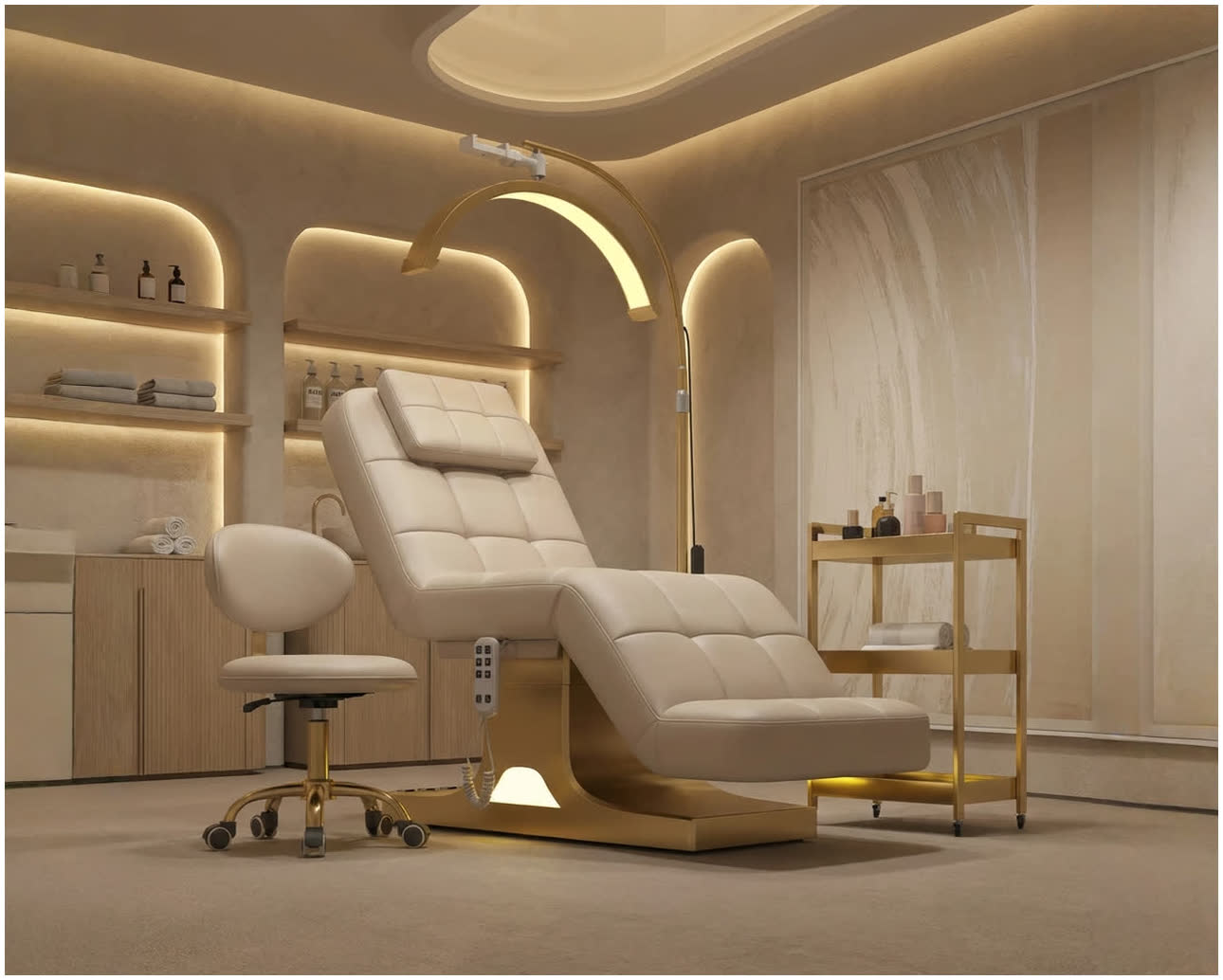
Treatment suites require motorized adjustability and unobstructed clinician mobility. Serving as the central clinical platform, the treatment couch requires quiet height adjustment and variable backrest tilt for facial therapies and body procedures. Multi-motor platforms allow practitioners to switch between seated and standing postures, preventing physical strain during long schedules.
Auxiliary equipment reinforces suite productivity. Mobile esthetician carts with quiet casters keep cosmetic devices and sterilized instruments within arm reach. Ergonomic clinician stools with contoured saddle seating promote neutral spine alignment, helping operators maintain precise hand stability during detailed procedures.
Nail and Pedicure Areas Require Different Furniture Architecture
Manicure stations require chemical-resistant work surfaces that withstand continuous contact with acetone and sanitizing sprays without dulling. Integrated down-draft dust extraction vents and concealed power channels preserve air quality and maintain tidy tabletops during intensive filing sessions.
Pedicure stations require robust plumbing integration and hygienic whirlpool engineering. Professional spa thrones utilize pipeless circulation to prevent bacterial accumulation, while motorized seat sliding accommodates diverse client physiques. Sourcing manicure tables, technician stools, and pedicure basins from one manufacturer ensures uniform timber finishes and upholstery stitching across the zone.
Hair, Shampoo, and Reception Zones Complete the Customer Flow
Styling stations require hydraulic chairs with heavy cast-iron pump bases that resist tipping and lock securely during cutting and color application. Shampoo backwash units demand deep tilting ceramic basins with cushioned neck rests and reinforced anti-leak plumbing engineered for continuous daily water flow.
Reception desks engineered with concealed wire raceways and appointment storage establish a refined corporate aesthetic upon arrival. Coordinating front-of-house casegoods with styling station materials unifies brand presentation from arrival to departure.
Evaluate Whether the Manufacturer Can Reproduce a Complete Furniture System
Procuring items from fragmented suppliers often causes material mismatches, inconsistent dye lots, and conflicting shipment schedules. Partnering with an integrated manufacturer capable of reproducing a comprehensive catalog resolves these operational risks. Madam Center manufactures across multiple categories, including treatment beds, styling chairs, manicure stations, pedicure units, and reception casegoods, guaranteeing visual and dimensional consistency across every room.
Consolidating whole-salon manufacturing under one engineering standard simplifies project coordination and container freight logistics. Unified material libraries allow operators to match upholstery tones, electroplated metal trims, and timber laminates across distinct furniture types. Single-source procurement also streamlines warranty management and future spare parts fulfillment.
Audit Manufacturing and Quality Controls Before Bulk Purchasing
Procurement managers should evaluate factory rigor through measurable engineering tolerances rather than marketing claims. Structural longevity begins at the frame, where laser-cut steel tubing and kiln-dried hardwood establish a deflection-free core. Automated robotic welding delivers consistent weld penetration across high-stress pivots, eliminating squeaks and joint fatigue.
Component-level endurance testing distinguishes commercial platforms from retail copies. Linear actuator motors and electronic controllers undergo multi-thousand-cycle load testing under full working weight, verifying thermal stability and quiet operation below 48 decibels. Protective finishes undergo salt-spray and disinfectant-wipe testing, while international shipments utilize reinforced cartons and wood crates to prevent transit impact.
Define Customization Before the Sample Stage
Customization allows luxury salons to express brand individuality, yet unmanaged changes risk production delays. Buyers should freeze critical parameters before manufacturing begins. Material selections must specify certified dye lots across stain-resistant silicone leathers, resilient cushioning, and metal platings. Dimensional adjustments, such as bed widths and height ranges, must be checked against floor plans and reach zones.
Branding and electrical controls require early engineering validation. Integrating debossed logos or custom embroidery requires vector sign-off during initial CAD planning. Control interfaces, whether base foot pedals, wireless switches, or hand remotes, must be locked into wiring schematics. A functional pilot sample lets operators verify ergonomics, motor acoustics, and seam alignment before volume fabrication.
Control Commercial Terms Around the Project Scope
Commercial terms should reflect production complexity and project volume. Madam Center maintains accessible manufacturing thresholds, offering flexible minimum orders starting from 10 units for standard catalog lines alongside comprehensive OEM and ODM capabilities. Structured payment milestones tied to blueprint approval, mid-stage assembly, and final container loading protect financial investments.
Establishing spare-parts allocations and warranty protocols upfront ensures uninterrupted salon operations. Direct sourcing from an established manufacturer provides long-term component availability, including standardized replacement motors, hand switches, and hydraulic pumps. Confirming container loading diagrams in advance prevents port delays and unexpected logistics charges.
Frequently Asked Questions about Salon Furniture Manufacturing
What Should a Distributor Prepare Before Requesting a Salon Furniture Quote?
Distributors should prepare a detailed project brief specifying room layouts, service zones, electrical requirements, and desired customization depth. Providing accurate dimensions, leather selections, and target installation timelines allows engineering teams to calculate precise component pricing and production lead times.
Is a Full-Category Supplier Always Better than Several Specialized Suppliers?
A full-category supplier offers significant advantages in finish uniformity, synchronized project delivery, and unified warranty coverage. Consolidating all salon furniture with one manufacturer prevents dye-lot variations across departments and lowers international freight costs through combined container shipping.
When Should a Buyer Approve Materials and Colors?
Material finishes, leather swatches, and hardware platings should be approved in person before pilot sample fabrication begins. Physical swatch review demonstrates how textures interact with salon lighting and confirms chemical resistance against daily sanitizers.
How Should Repeat Orders Be Protected from Specification Drift?
Repeat-order consistency is safeguarded by archiving complete technical master records, including CAD drawings, electrical schematics, and approved material swatches. Professional manufacturers assign unique project tracking codes to archived files, ensuring subsequent branch fit-outs receive identical equipment.
What Should High-End Salon Buyers Prioritize Beyond Appearance?
Buyers should examine structural frame stability, motor noise levels below 48 decibels, ergonomic operator clearances, and chemical upholstery resistance. Equipment that operates smoothly and withstands continuous chemical sanitization protects salon reputation and avoids premature replacement.
Build the Project Around One Controlled Specification Set
Executing a luxury salon fit-out requires aligning functional ergonomics, mechanical engineering, material resilience, and international logistics. Sourcing treatment beds, styling chairs, manicure stations, and reception furniture under one unified production standard eliminates the operational friction of managing multiple disconnected vendors.
Distributors, spa developers, and salon chain operators are invited to consult with Madam Center. Contact the engineering team or visit https://www.madamcenter.com/ to submit floor plans and receive a customized salon furniture specification package.
Madam Center
Madam Center
Legal Disclaimer:
EIN Presswire provides this news content “as is” without warranty of any kind. We do not accept any responsibility or liability
for the accuracy, content, images, videos, licenses, completeness, legality, or reliability of the information contained in this
article. If you have any complaints or copyright issues related to this article, kindly contact the author above.

Media gallery