
The Business Research Company’s Smart Infrastructure Global Market Report 2026 – Market Size, Trends, And Forecast 2026-2035
LONDON, GREATER LONDON, UNITED KINGDOM, October 28, 2026 /EINPresswire.com/ — The smart infrastructure sector is rapidly evolving, driven by technological advancements and increasing investments worldwide. As cities and industries seek smarter and more efficient systems, this market is set to experience substantial expansion over the next several years. Let’s explore the market’s growth prospects, key drivers, major players, and emerging trends shaping its future.
Market Size and Growth Forecast in the Smart Infrastructure Market
The smart infrastructure market is anticipated to grow by more than $472 billion between 2025 and 2030. This surge will be distributed across hardware, software, and services, with hardware contributing $208 billion, software $159 billion, and services $105 billion. Competition among global technology providers, industrial automation companies, digital infrastructure developers, and intelligent building vendors centers on AI-powered infrastructure management, IoT monitoring, cloud-connected controls, energy optimization, and smart mobility solutions. Core priorities for these players include enhancing operational efficiency, enabling real-time asset monitoring, ensuring sustainability, bolstering cybersecurity, and achieving seamless integration.
Request A Free Sample Of The Smart Infrastructure Market Report
https://thebusinessresearchcompany.com/sample_request?id=23470074&type=smp&name=Smart%20infrastructure%20Market%20Report%202026&utm_source=EINPresswire&utm_medium=Paid&utm_campaign=Oct_PR
Electrification Platforms’ Expanding Influence on the Smart Infrastructure Market
Electrification platforms are playing an increasingly vital role by improving energy efficiency, enhancing grid resilience, and facilitating intelligent management of interconnected energy systems.
A notable example occurred in April 2024, when Siemens AG introduced Electrification X, a digital platform designed to accelerate electrification infrastructure transformation in commercial, industrial, and utility environments. This cloud-based solution incorporates interoperable software modules and smart energy management features that optimize asset utilization, streamline operations, and support the integration of distributed energy resources for scalable and sustainable infrastructure development.
How IoT, Smart City Investments, and Sustainability Ambitions Propel Smart Infrastructure Growth
The growth of the smart infrastructure market through 2030 is primarily fueled by three key trends: the proliferation of IoT and connected devices, escalating smart city investments, and a rising emphasis on energy efficiency and sustainability throughout infrastructure ecosystems worldwide.
Access The Detailed Smart Infrastructure Market Report Here
https://thebusinessresearchcompany.com/report/smart-infrastructure-market-report?utm_source=EINPresswire&utm_medium=Paid&utm_campaign=Oct_PR
Increasing Adoption of IoT and Connected Devices
Organizations are widely deploying sensors, smart meters, and connected equipment to monitor infrastructure assets in real time. This adoption improves operational efficiency, minimizes downtime, and enables predictive maintenance. Furthermore, the ability to collect and analyze data rapidly supports quicker decision-making and better resource management. This expanding connectivity is expected to contribute around 2.5% annual growth to the market.
Rising Investments in Smart City Development
Governments and municipalities are prioritizing intelligent transport systems, modern energy networks, and digitally connected utilities to enhance mobility, service delivery, and urban management. Accelerated public and private funding is propelling these initiatives in both developed and emerging markets. This focus on smart cities is projected to drive approximately 2.2% annual growth within the market.
Growing Demand for Energy Efficiency and Sustainability
Both industries and public institutions are turning to smart infrastructure solutions to reduce energy consumption, boost asset performance, and achieve environmental goals. Technologies such as smart grids, automated building systems, and digital resource monitoring enable more efficient, cost-effective management. Sustainability initiatives and regulatory compliance requirements are further speeding up adoption, with this trend expected to add about 1.7% to annual growth.
Projected Market Expansion and Share Within the Broader Information Technology Landscape
The smart infrastructure market is forecast to reach more than $688 billion by 2030, growing at a compound annual growth rate (CAGR) of 26%. It represents roughly 22% of the broader Software Products market, which itself is anticipated to be valued at approximately $3,198 billion by the same year. Within the extensive Information Technology sector, expected to hit $13,788 billion by 2030, smart infrastructure will account for nearly 5% of the total market value.
Asia Pacific Leads with Rapid Smart Infrastructure Growth Driven by Smart City Spending
By 2030, the Asia Pacific region is set to become the largest market for smart infrastructure, valued at $337 billion, up from $100 billion in 2025. This robust growth, marked by a 27% CAGR, stems from rapid urbanization, substantial government investments in smart cities, improvements in digital public services, connected transportation and utility systems, and intelligent platforms that enhance operational efficiency and urban sustainability.
China’s Smart Infrastructure Market Emerges as a Global Powerhouse
China is projected to be the largest national market by 2030, reaching $160 billion from $47 billion in 2025, growing at a 28% CAGR. This expansion will be propelled by nationwide smart city initiatives, widespread deployment of AI- and IoT-enabled urban infrastructure, strong investments in intelligent transport and energy networks, digital public infrastructure modernization programs, and integrated management systems designed to optimize city operations and resource utilization.
Hardware’s Dominant Role in the Smart Infrastructure Market
Within the smart infrastructure market, hardware remains the largest sector, expected to comprise 45% of the total market or approximately $309 billion by 2030. Growth in this segment is driven by the increasing deployment of IoT sensors, smart meters, surveillance cameras, and connected control devices. Investments in communication and networking infrastructure, intelligent traffic and energy management equipment, edge computing devices for real-time monitoring, and ongoing upgrades of public infrastructure assets also support this expansion.
Key Segments Defining the Smart Infrastructure Market
The market is divided into several segments based on type, technology, application, and end-user categories:
– By Type: smart transportation systems, smart energy management systems, smart safety and security systems, smart waste management solutions, and others.
– By Technology: Internet of Things (IoT), artificial intelligence and analytics, cloud computing, edge computing, digital twin technology, and blockchain.
– By Application: energy management, traffic and mobility management, building automation, safety and security management, environmental monitoring, and utility management.
– By End User: government and municipalities, utilities, transportation authorities, commercial enterprises, industrial sector, and residential sector.
Huawei’s Leadership in the Smart Infrastructure Market
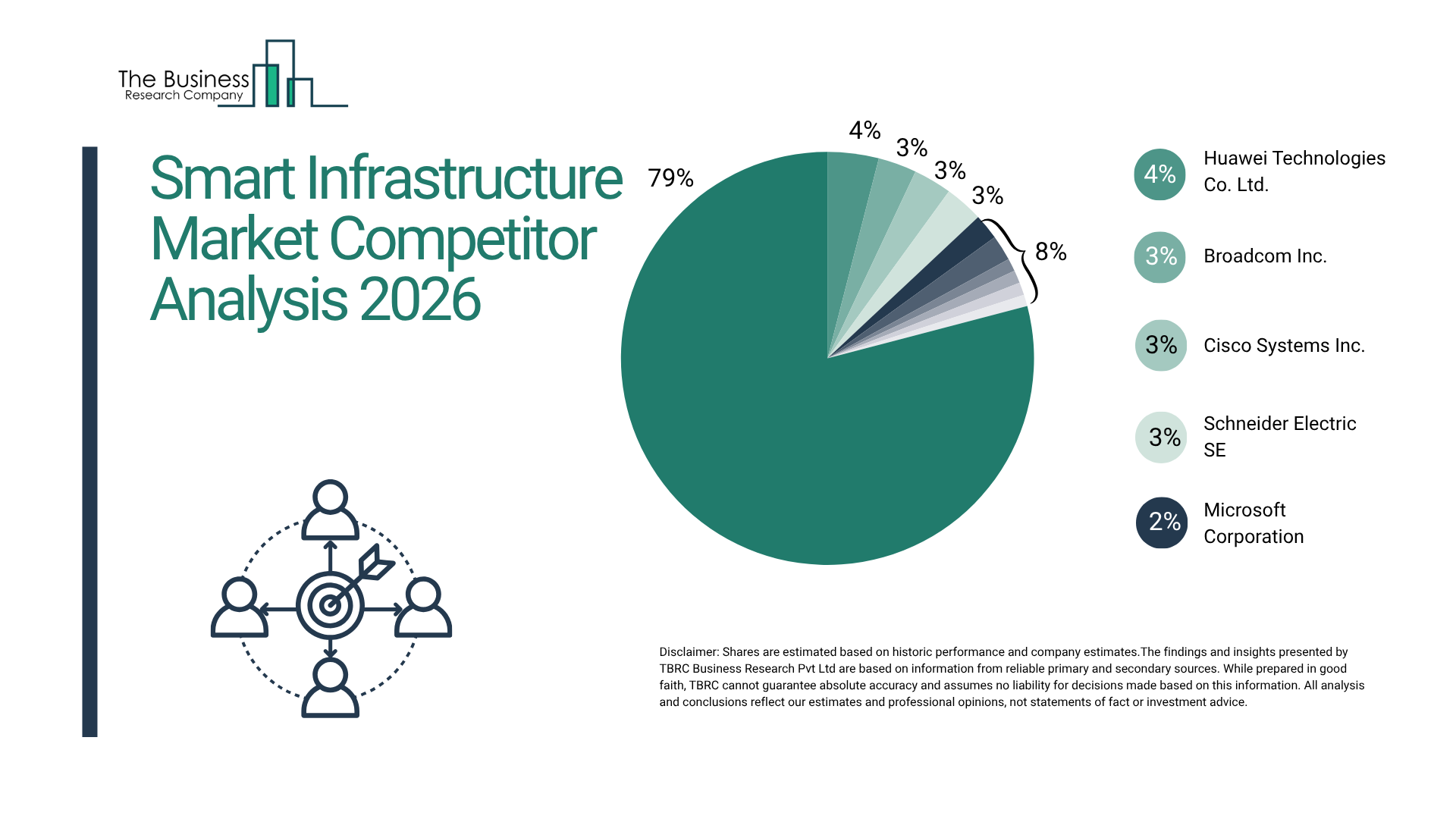
According to The Business Research Company, Huawei Technologies Co. Ltd. maintained the top global sales position in 2025 with a 4% market share. Huawei’s smart infrastructure offerings include digital power solutions, intelligent campus platforms, smart city technologies, data center infrastructure, and IoT connectivity, all of which support automation, modernization, efficiency, and sustainable urban development across public and private sectors.
A Glimpse at the Smart Infrastructure Market’s Leading Companies
The market features several prominent players, including Huawei Technologies Co. Ltd., Broadcom Inc., Cisco Systems Inc., Schneider Electric SE, Microsoft Corporation, Siemens AG, Apple Inc., International Business Machines Corporation, Oracle Corporation, Nokia Corporation, Xylem Inc., ABB Ltd., Wipro Ltd., Hewlett Packard Enterprise Company, Hitachi Ltd., Honeywell International Inc., Bentley Systems Incorporated, Itron, Inc., Larsen & Toubro Technology Services Limited, Aclara Technologies LLC, and Dynamic Ratings Inc.
Market Fragmentation and Top Players’ Influence on Competition
The smart infrastructure market is moderately fragmented, with the ten largest companies accounting for 21% of total revenue in 2025. This composition reflects moderate barriers related to technology and integration, shaped by the demand for connected ecosystems, platform interoperability, advanced software capabilities, and expertise in large-scale implementation and lifecycle management. Leading firms maintain significant market shares through diversified portfolios, broad digital technology strengths, global customer bases, and continued innovation in AI, cloud infrastructure management, and intelligent connectivity. As demand grows for infrastructure modernization, energy-efficient operations, and integrated urban ecosystems, competitive positions are expected to strengthen through innovation, partnerships, and expanded service offerings.
Market Shares of Leading Companies in 2025
– Huawei Technologies Co. Ltd. — 4%
– Broadcom Inc. — 3%
– Cisco Systems Inc. — 3%
– Schneider Electric SE — 3%
– Microsoft Corporation — 2%
– Siemens AG — 2%
– Apple Inc. — 1%
– International Business Machines Corporation — 1%
– Oracle Corporation — 1%
– Nokia Corporation — 1%
Key Competitive Strategies in the Smart Infrastructure Market
Industry leaders are focusing on several approaches to maintain and expand their market presence, including:
– Leveraging AI-based infrastructure management to boost operational efficiency
– Expanding digital twin platforms for advanced asset monitoring
– Integrating edge computing throughout connected infrastructure networks
– Forming strategic alliances to accelerate modernization of smart cities and energy grids
– Providing cloud-based energy management platforms to promote sustainable infrastructure
Smart Infrastructure Supply Chain and Principal End Users
The supply chain for smart infrastructure involves a broad array of raw material suppliers such as Texas Instruments, STMicroelectronics, Infineon Technologies, NXP Semiconductors, Analog Devices, Renesas Electronics, Qualcomm Technologies, Intel Corporation, Micron Technology, Samsung Electronics, SK hynix, Murata Manufacturing, TDK Corporation, TE Connectivity, Amphenol Corporation, Corning Incorporated, CommScope Holding Company, Belden Inc., and Prysmian Group.
Wholesalers and distributors include Arrow Electronics, Avnet, WESCO International, Rexel Group, Sonepar, Ingram Micro, TD SYNNEX, Anixter International, Graybar Electric Company, RS Group, Farnell, DigiKey Electronics, Mouser Electronics, Future Electronics, Electrocomponents, ScanSource, Exclusive Networks, Westcon-Comstor, and Redington Limited.
End users cover major entities such as State Grid Corporation of China, National Grid plc, EDF Group, Enel Group, Duke Energy, NextEra Energy, Southern Company, Prologis, and CBRE Group.
The Contribution of Hardware, Software, and Services to Market Growth
Together, hardware, software, and services are poised to add more than $472 billion in value to the smart infrastructure market by 2030. Hardware will contribute $208 billion, software $159 billion, and services $105 billion between 2025 and 2030. Growth areas include intelligent projects in transportation, utilities, and buildings; demand for integrated digital platforms that enhance visibility and resilience; connected infrastructure upgrades; and advanced intelligent devices, analytics, and lifecycle support. This overall expansion reflects the broader drive to digitize critical infrastructure and improve its management through data-driven solutions.
Our latest 2026 market reports provide expanded strategic and visual intelligence with market attractiveness scoring and analysis, total addressable market (TAM) analysis, company scoring matrix graphics and tables, Excel-based forecasting dashboards, market hotspots infographics, key technologies and future trend analysis, together with updated graphics and tables.
Learn More About The Business Research Company
The Business Research Company (www.thebusinessresearchcompany.com) is a leading market intelligence firm renowned for its expertise in company, market, and consumer research. We have published over 30,000+ reports across 27 industries and 60+ geographies. Our research is powered by 1,500,000 datasets, extensive secondary research, and exclusive insights from interviews with industry leaders.
We provide continuous and custom research services, offering a range of specialized packages tailored to your needs, including Market Entry Research Package, Competitor Tracking Package, Supplier & Distributor Package and much more.
Disclaimer: Please note that the findings, conclusions and recommendations that TBRC Business Research Pvt Ltd delivers are based on information gathered in good faith from both primary and secondary sources, whose accuracy we are not always in a position to guarantee. As such TBRC Business Research Pvt Ltd can accept no liability whatever for actions taken based on any information that may subsequently prove to be incorrect. Analysis and findings included in TBRC reports and presentations are our estimates, opinions and are not intended as statements of fact or investment guidance.
Contact Us:
The Business Research Company
Americas +1 310-496-7795
Europe +44 7882 955267
Asia & Others +44 7882 955267 & +91 8897263534
Email: marketing@tbrc.info
Follow Us On:
LinkedIn: https://in.linkedin.com/company/the-business-research-company
Oliver Guirdham
The Business Research Company
+44 7882 955267
Visit us on social media:
LinkedIn
Facebook
X
Legal Disclaimer:
EIN Presswire provides this news content “as is” without warranty of any kind. We do not accept any responsibility or liability
for the accuracy, content, images, videos, licenses, completeness, legality, or reliability of the information contained in this
article. If you have any complaints or copyright issues related to this article, kindly contact the author above.

Media gallery