
How AI tools give communications leaders real-time narrative intelligence to protect brand reputation
Austin, United States – March 31, 2026 / Handraise Inc /
Key Takeaways
AI media monitoring is no longer a future capability — it’s the new baseline for enterprise communications teams.
-
Traditional monitoring tools produce quarterly reports that arrive after the narrative has already been set
-
AI-powered tools now analyze sentiment, cluster related coverage into narratives, and track how LLMs perceive your brand
-
Communications leaders who rely on Boolean searches and manual data cleaning are working at a significant strategic disadvantage
-
If your monitoring strategy doesn’t include real-time narrative intelligence and LLM perception tracking, you’re not fully measuring your reputation.
Media monitoring has always been a core communications responsibility. For most of the past two decades, it meant collecting mentions, compiling them into a report, and hoping the data told a coherent story before it reached leadership. That approach worked — barely — in a slower media environment. Today, it’s a liability.
AI-powered platforms can now track brand mentions across thousands of sources, analyze sentiment trends, and identify emerging issues before they become crises. That’s quickly becoming the minimum expectation for enterprise communications teams that want to stay ahead of the stories defining their brands.
The shift happening right now in AI media monitoring is about a fundamental question: how quickly can your team understand what’s being said about your brand, what narrative is forming, and what to do about it?
What Has Changed About AI Media Monitoring?
For years, media monitoring operated on Boolean logic — keyword strings that pulled in results based on exact phrase matches. Communications teams then sorted through volumes of largely irrelevant coverage to find what actually mattered. It was slow, imprecise, and exhausting.
AI changes that equation at every step. Instead of matching keywords, AI-powered tools use natural language processing to understand context, relevance, and meaning. They can distinguish between a headline mention and a passing reference. They can assess whether coverage is favorable, neutral, or damaging — and they can do it instantly across thousands of sources. The practical outcome communications leaders care about is less time buried in raw data and more time making decisions informed by it.
According to PR News, AI-driven monitoring tools are raising the bar across PR and communications — from targeting and research to monitoring and analysis — and the shift is only accelerating.
From Mentions to Narratives
Here’s where automated media monitoring has taken its most meaningful leap. Counting mentions tells you how much is being said about your brand. Understanding narratives tells you what story is forming.
These are very different insights. A spike in brand coverage might look positive in a raw mentions report — but if the underlying narrative clusters around a product concern or a leadership controversy, the volume number is actually a warning sign. AI tools that group related coverage into coherent themes give communications teams the contextual intelligence they need to act, not just observe.
This is also why real-time reputation tracking has become such a priority. By the time a quarterly analysis report is compiled, the narrative has often already hardened in the public mind. The communications window — the period during which a team can actively shape perception — has passed.
The Publication Tier Problem
Not all coverage carries equal weight, but traditional monitoring tools treat it that way. A mention in a niche industry newsletter and a feature in a top-tier national publication both show up as one data point in a basic count. AI-powered systems can assign weight based on domain authority, readership, and social amplification — making it possible to understand not just what’s being said, but how far it’s reaching and who’s likely seeing it.
The communications teams seeing the most value from publication tiering are those that understand reach is only meaningful when it’s contextualized — a byline in a high-authority national outlet carries categorically different weight than a blog post, and modern monitoring platforms surface that distinction automatically.
How Are AI PR Tools Transforming Speed and Accuracy?
Speed is the headline benefit, but accuracy might be the more valuable one. Manual monitoring is not just slow — it’s inconsistent. Human reviewers apply different judgment to sentiment, relevance, and impact. AI applies the same logic at scale, every time, across every source. That consistency is especially critical when you’re tracking multiple brands, product lines, or competitive narratives simultaneously.
McKinsey’s 2024 Global Survey on AI found that adoption jumped to 72% of organizations using AI in at least one business function — up from 55% the year before. Communications is no exception. The teams that have integrated AI PR tools into their workflows — and specifically this layer of narrative intelligence — report a meaningful reduction in the time it takes to understand what’s happening with their brand coverage, and significantly more confidence that they’re not missing something critical.
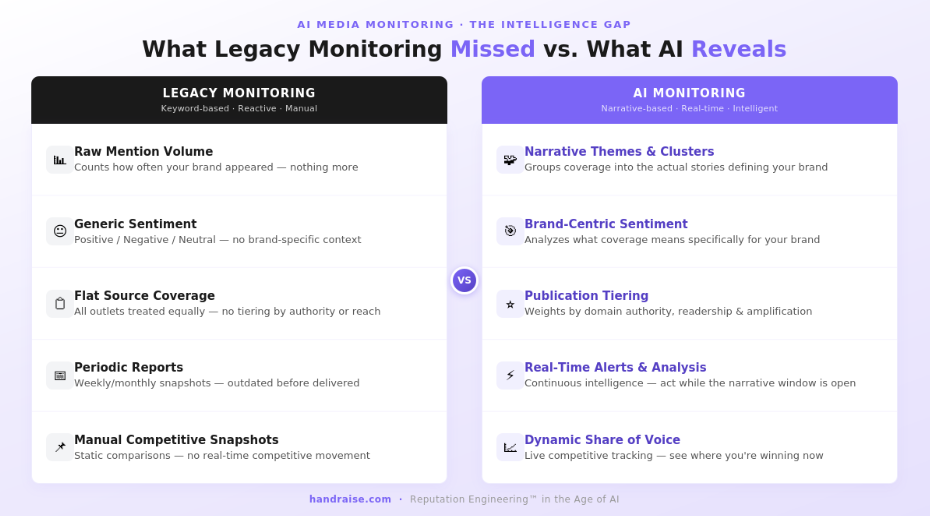
|
What Legacy Monitoring Measured |
What AI Monitoring Reveals |
|
Raw mention volume |
Narrative themes and clustering |
|
Basic positive/negative sentiment |
Brand-centric sentiment in context |
|
Uniform source coverage |
Publication tiering by authority and reach |
|
Weekly or monthly reports |
Real-time alerts and continuous analysis |
|
Manual competitive snapshots |
Dynamic share of voice across competitors |
The table above isn’t just a product comparison — it reflects a strategic gap. Teams still operating in the left column are making reputation decisions based on incomplete intelligence.
Where Accuracy Matters Most: Sentiment Analysis
Brand-centric sentiment is a concept worth understanding carefully. Standard sentiment tools assess whether a piece of content is positive or negative in general. That’s useful, but it doesn’t answer the question that matters to a communications leader: is this coverage positive or negative for my brand specifically?
A story about a competitor’s crisis might generate broadly negative sentiment — but if your brand is mentioned favorably within it, the effect on your reputation is actually positive. AI tools sophisticated enough to understand this distinction deliver meaningfully more accurate intelligence than those applying generic sentiment scoring.
Modern PR measurement frameworks are increasingly built around this kind of brand-specific context — moving away from vanity metrics and toward insights that can actually inform executive decisions.
Why LLMs Are Now a Critical Audience for Brand Communications
Here’s the shift that most communications teams are not yet fully tracking: the audiences that matter for brand perception are no longer exclusively human.
ChatGPT alone now processes 2.5 billion prompts daily, and AI-powered search tools are increasingly where buyers, journalists, and decision-makers go to research brands, industries, and competitors. That makes AI systems a critical audience — one most communications teams aren’t yet monitoring.
When someone asks ChatGPT, Perplexity, or another AI assistant about your company, industry, or leadership team, the answer they receive is shaped by the earned media landscape around your brand. Research from Edelman found that up to 90% of the citations driving brand visibility in LLMs originate from earned media — third-party editorial coverage is the primary input for how AI systems describe your brand, not paid placements or owned content.
That means the narratives your brand is associated with in earned media directly determine how AI systems describe you. A brand that proactively shapes its narrative clusters — the dominant stories appearing in coverage — is a brand that influences what LLMs say about it. A brand that’s reactive, or that simply counts mentions without understanding narrative themes, is ceding that influence.
What This Means for Communications Strategy
Large language models are becoming the primary interface for how people research products, evaluate options, and make decisions. The way a brand appears — or doesn’t — within these responses can shape perception, influence consideration, or eliminate you from the conversation entirely.
For enterprise communications leaders, this has a direct implication: media monitoring is no longer just about tracking earned coverage. It’s about understanding how that coverage is training AI systems to describe your brand — and whether those descriptions align with the story you want told.
What Does Effective Real-Time Reputation Tracking Look Like?
Effective reputation tracking in 2025 and beyond isn’t a dashboard of mentions and a weekly PDF report. It’s a continuous intelligence operation that answers three questions in real time: What narratives are forming? Are they net positive or negative for the brand? And where is the brand winning or losing ground against its competitive set?
The most capable communications teams are moving toward a model that integrates narrative intelligence into PR strategy — not as an afterthought, but as the foundation. They’re asking: what are the dominant stories defining our brand right now? Which publications and sources are amplifying them? Are those narratives reflected accurately in what AI systems say about us? Automated media monitoring makes this kind of continuous awareness possible without the staffing overhead that manual analysis requires.
The Share of Voice Blind Spot
Traditional share of voice reporting is typically static — a snapshot of coverage volume over a defined period, compared across competitors. Dynamic share of voice tracks how a brand’s competitive position shifts as new coverage emerges, giving communications teams a much more actionable view. If a competitor just received a wave of favorable coverage on a topic where your brand is also active, that’s something to know now, not next quarter.
How proactive brands shape reputation narratives is increasingly tied to this kind of real-time competitive intelligence. The teams that respond in hours rather than weeks are the ones setting the story, not following it.

Frequently Asked Questions About AI Media Monitoring
What is AI media monitoring, and how does it differ from traditional tools?
AI media monitoring uses machine learning and natural language processing to automatically track, analyze, and interpret brand coverage across news and online publications. Unlike traditional monitoring tools — which match keywords and require significant human sorting — AI systems understand context, cluster related stories into narratives, assign sentiment with brand-specific accuracy, and surface insights in real time.
How does AI media monitoring help communications teams save time?
The biggest time savings come from eliminating manual data cleaning and analysis. Traditional monitoring often requires sorting large volumes of irrelevant results, manually applying sentiment judgments, and compiling findings over weeks — or a full quarter. AI tools automate the analysis layer, surfacing the narratives and insights that matter without extensive human processing.
Why should communications teams care about how LLMs perceive their brand?
AI assistants like ChatGPT and Perplexity are increasingly where people go to research companies, industries, and products. The descriptions these tools generate are based largely on earned media coverage. If the dominant narratives in your coverage are inaccurate or unfavorable, that’s likely how AI systems will describe you — explored further in our overview of PR analytics for executives.
Stop Monitoring. Start Engineering.
The communications teams that will define their categories over the next several years share one thing in common: they’re not waiting for coverage to arrive and then reacting to it. They’re using narrative intelligence to understand what’s forming, act while the window is open, and influence how both human audiences and AI systems understand their brands.
That shift — from reactive monitoring to proactive narrative shaping — is what separates communications as a reporting function from communications as a strategic capability. The tools now exist to make that shift. The question is whether your team is using them.
Handraise was built specifically for this moment — combining real-time AI media monitoring, patented narrative clustering, brand-centric sentiment analysis, and LLM perception tracking into a single intelligence platform for enterprise communications leaders. If you’re ready to move beyond the dashboard and start engineering your reputation, book a demo with Handraise to see it in action.


Contact Information:
Handraise Inc
1135 W 6th St., Suite 110A
Austin, TX 78703
United States
Matt Allison
https://www.handraise.com/


