Full Closed-Loop Recycling Ecosystem Market Size and Share Forecast Outlook 2026 to 2036
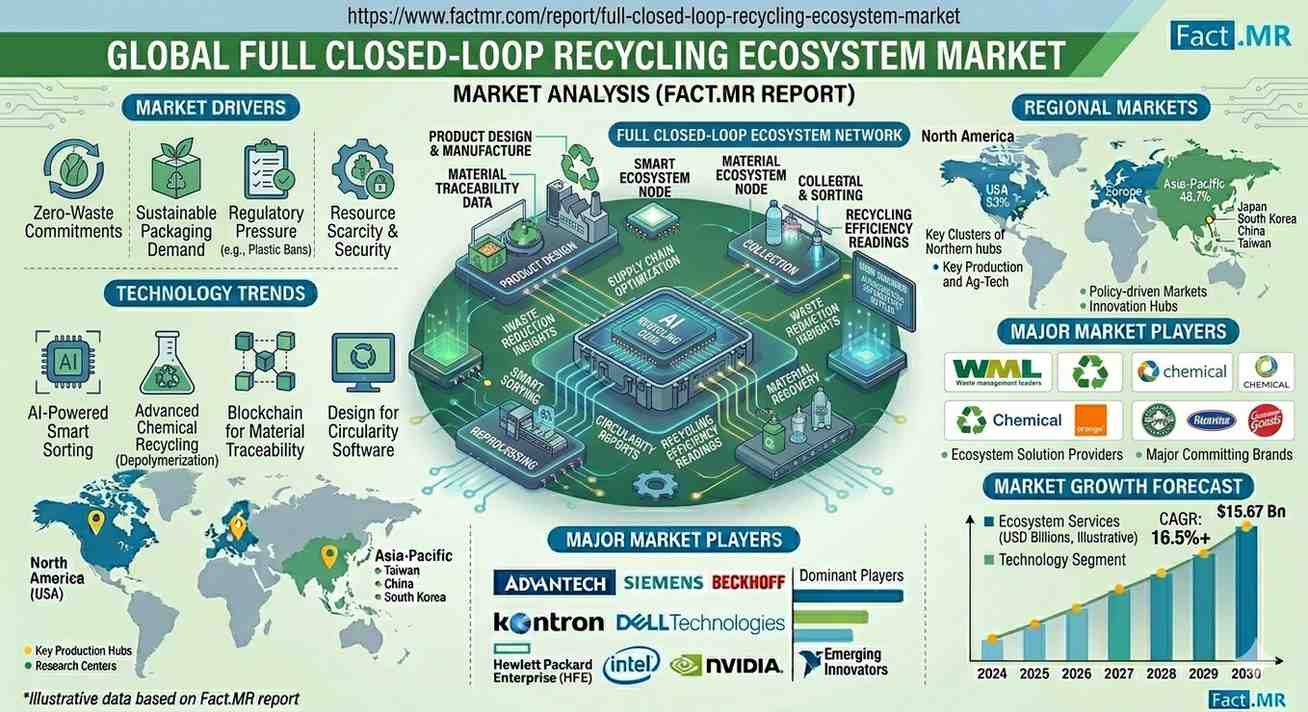
ROCKVILLE, MD, UNITED STATES, April 8, 2026 /EINPresswire.com/ — The global Full Closed-Loop Recycling Ecosystem market is undergoing a structural transformation, projected to grow from USD 5.4 billion in 2026 to USD 15.9 billion by 2036. This nearly threefold increase, representing an 11.4% CAGR, marks a decisive shift from traditional linear waste management to integrated circularity models where material value is retained through repeated recovery and reuse.
As global sustainability mandates intensify, purchasing decisions are increasingly decoupled from pure cost metrics, favoring suppliers who can provide “end-to-end” circularity. The market is currently dominated by integrated systems that combine sorting, washing, regranulation, and digital traceability, a segment that holds a 57% market share in 2026.
Get Access Report Sample :
https://www.factmr.com/connectus/sample?flag=S&rep_id=13659
Executive Market Summary (2026–2036)
2026 Valuation: USD 5.4 Billion
2036 Projection: USD 15.9 Billion
CAGR:4%
Leading Technology: Sorting + Washing + Regranulation + Traceability (57% Share)
Leading Materials: PET, PE, and PP (55% Share)
Strategic Segment Insights
The Power of Traceability & Integrated Tech
The “Sorting + Washing + Regranulation + Traceability” segment is the foundational pillar of the market. Beyond physical processing, digital traceability has become a non-negotiable requirement for brand owners (FMCG, Automotive) who must verify recycled content to meet regulatory audits and consumer transparency demands.
Material Scope: The Plastics Core
PET, PE, and PP continue to anchor the ecosystem with a 55% share. These materials are the primary focus of “brand-led closed loops,” where companies like Dow and BASF (via ChemCycling) link recycled outputs directly back into high-purity production lines for food-grade packaging and engineering plastics.
Regional Outlook: India and China Spearhead Circular Growth
Asia-Pacific is emerging as the high-growth engine of the market, driven by massive industrialization and aggressive environmental policy frameworks.
Country
Projected CAGR (2026-2036)
Strategic Driver
India
14.4%
Rapid urbanization and a robust push for sustainable waste management.
China
13.6%
Large-scale manufacturing and government “circular economy” initiatives.
Brazil
11.2%
Rising pressure to improve national recycling rates and infrastructure.
USA
11.0%
Corporate sustainability commitments and localized industrial recycling parks.
Germany
10.6%
Mature leadership in Industrie 4.0 circularity and strict EU mandates.
Competitive Landscape: Who Supplies Whom?
The competitive frontier is defined by the ability to secure high-quality feedstock and integrate it back into the manufacturing stream.
Integrated Giants: Veolia and WM (Waste Management) utilize their vast collection networks to supply high-volume recyclate to global OEMs and packaging firms.
Chemical Innovators: BASF (ChemCycling) and Dow are competing by integrating recycled feedstocks directly into chemical production lines, allowing for “molecular” closed loops.
Regional Specialists: GEM Co. and Everbright Environment are dominating the Asia-Pacific region by deploying modular sorting and conversion facilities within industrial parks.
Tech Leaders: JEPLAN and DOWA Eco-System focus on advanced chemical recycling and modular processing to achieve higher material purity than standard mechanical methods.
Actionable Intelligence for Decision-Makers
Investment Opportunities
Digital Product Passports: Significant ROI is expected in blockchain-enabled traceability tools that certify the “pedigree” of recycled materials.
Industrial Recycling Parks: Investing in co-located collection and reprocessing centers minimizes logistics costs and reduces the carbon footprint of the circular loop.
Market Risks & Challenges
Contamination Barriers: Mixed-material streams remain a technical hurdle, often degrading the quality of recycled outputs and limiting their use in high-precision sectors like electronics.
CapEx Requirements: The high cost of advanced automated sorting and extrusion equipment remains a barrier for regional players in developing markets.
Future Outlook: From Recycling to “Resource Management”
By 2036, the market will move beyond “waste management” to a Resource-as-a-Service (RaaS) model. In this future state, manufacturers will no longer “buy” raw materials but will instead participate in perpetual “material leases” managed by closed-loop ecosystem providers, ensuring 100% material recovery and zero leakage into the environment.
Browse Full Report –
https://www.factmr.com/report/full-closed-loop-recycling-ecosystem-market
To View Related Report:
Digital Product Ecosystems Using PCR for Consumer Goods Market https://www.factmr.com/report/digital-product-ecosystems-using-pcr-for-consumer-goods-market
AI-Enabled Recycling Infrastructure Market https://www.factmr.com/report/ai-enabled-recycling-infrastructure-market
Digital Twin Modeling for Recycling Plant Operations Market https://www.factmr.com/report/digital-twin-modeling-for-recycling-plant-operations-market
High-Speed Memory Signal Integrity Test Market https://www.factmr.com/report/high-speed-memory-signal-integrity-test-market
S. N. Jha
Fact.MR
+1 628-251-1583
email us here
Legal Disclaimer:
EIN Presswire provides this news content “as is” without warranty of any kind. We do not accept any responsibility or liability
for the accuracy, content, images, videos, licenses, completeness, legality, or reliability of the information contained in this
article. If you have any complaints or copyright issues related to this article, kindly contact the author above.

Media gallery