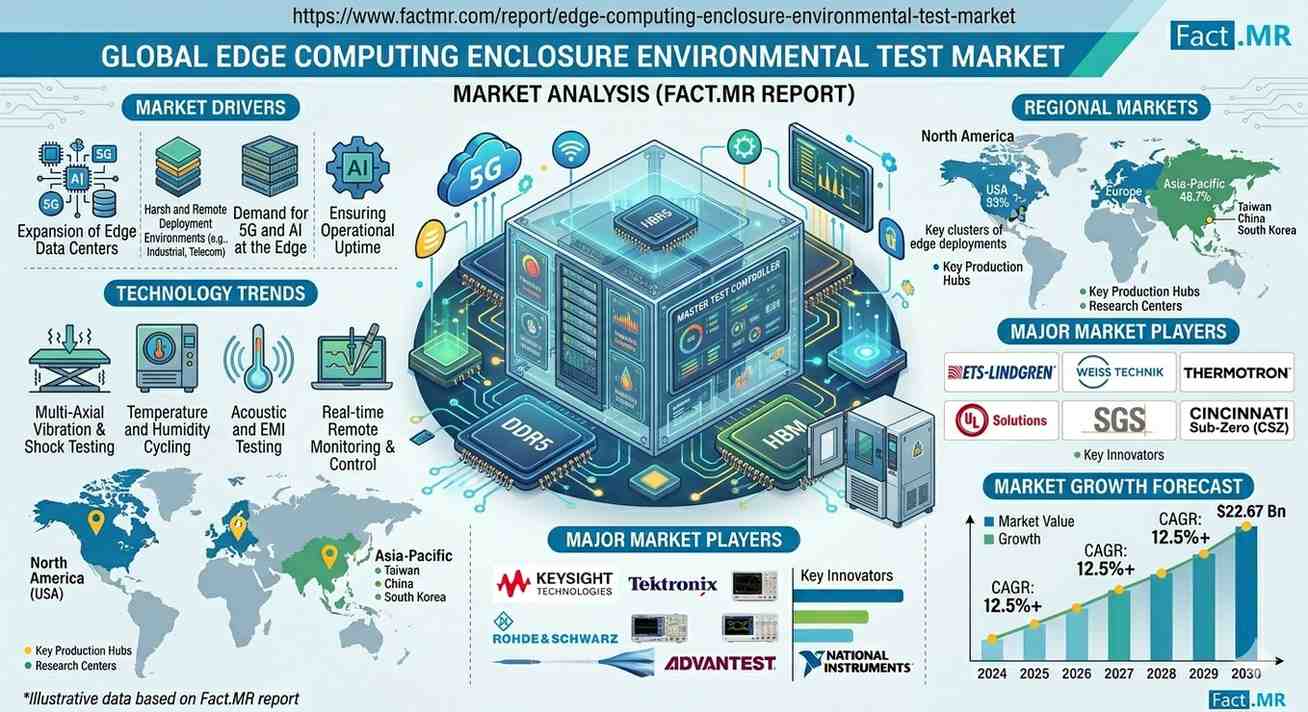
5G expansion and rugged data center testing drive market demand
ROCKVILLE, MD, UNITED STATES, April 16, 2026 /EINPresswire.com/ — According to the latest analysis by Fact MR, the South Korea edge computing enclosure environmental test market is entering a pivotal growth phase as the nation’s telecommunications and industrial sectors demand unprecedented hardware durability.
The market is valued at USD 0.45 billion in 2026 and is projected to reach USD 0.87 billion by 2036. Growing at a steady CAGR of 6.9%, the industry presents an incremental opportunity of USD 0.42 billion over the forecast period. This expansion is fundamentally driven by the rapid deployment of 5G infrastructure and the proliferation of “edge-of-network” facilities that require rigorous validation against the peninsula’s diverse and often harsh environmental conditions.
Get detailed market forecasts, competitive benchmarking, and pricing trends:
https://www.factmr.com/connectus/sample?flag=S&rep_id=13277
Quick Stats Section
Market Size (2026): USD 0.45 Billion
Market Size (2037): USD 0.87 Billion
CAGR (2026–2036):9%
Total Growth:3%
Leading Segment: Temperature or Humidity Cycling (36% Share)
Dominant Enclosure Class: Outdoor Micro-Data Centers (34% Share)
Leading Region: South Korea (Core Focus)
Key Players: ESPEC, Weiss Technik, Thermotron, Cincinnati Sub-Zero, Binder, TÜV SÜD.
Executive Insight for Decision Makers
The market is witnessing a critical transition from simple hardware protection to holistic environmental “resilience engineering.” For OEMs and investors, the priority has shifted toward automated multi-standard testing systems that can simulate a product’s entire lifecycle in a fraction of the time.
“In South Korea’s hyper-connected landscape, an enclosure failure isn’t just a maintenance issue—it’s a network blackout,” notes a senior market analyst. “Decision-makers must move beyond basic IP ratings and invest in advanced vibration, shock, and salt fog validation. The risk of not adapting is not just financial; it is a loss of institutional trust in critical 5G and Smart City infrastructure.”
Market Dynamics
Key Growth Drivers:
5G Network Densification: Massive rollout of small cells and edge shelters requiring localized environmental stress testing.
Regulatory Rigor: Mandatory compliance with IEC 60529, NEBS, and MIL-STD for government and telecom contracts.
Automation Trends: Adoption of AI-driven testing platforms that minimize manual analysis and interpretation errors.
Key Restraints:
High CAPEX: The substantial initial cost of specialized multi-environment test chambers.
Integration Complexity: Difficulties in merging advanced test data into existing R&D workflows.
Emerging Trends:
Digital Twin Testing: Using virtual environmental mapping to optimize physical test protocols.
Specialized Multi-Standard Systems: Hardware capable of simultaneous vibration, humidity, and temperature testing.
Segment Analysis
The Temperature or Humidity Cycling segment remains the market cornerstone with a 36% share, as it represents the most fundamental stressor for electronics longevity. However, the Outdoor Micro-Data Center class is the primary growth engine (34% share), fueled by the decentralization of cloud services. These segments are strategically vital as they serve as the first line of defense for the “brains” of South Korea’s smart industrial zones.
Supply Chain Analysis
The supply chain is characterized by high technical barriers and specialized procurement:
Raw Material Suppliers: Provide high-grade sensors, cooling systems, and specialized alloys for test chamber construction.
Manufacturers/Producers: Global leaders (e.g., ESPEC, Weiss Technik) design and manufacture the sophisticated chambers.
Distributors: Localized South Korean technical partners provide sales, calibration services, and regulatory guidance.
End-Users: Telecom giants (SK Telecom, KT), Industrial/Energy firms, and Smart City developers.
Interdependency: Manufacturers supply highly customized “turnkey” labs to end-users, while distributors act as the critical bridge for certification and localized compliance.
Pricing Trends
Tiered Pricing: The market bifurcates between commodity chambers (standard humidity) and premium multi-stress platforms (vibration + temperature + corrosion).
Influencing Factors: Raw material costs (stainless steel, refrigerants), sensor precision, and specialized certifications (UL/CE) significantly impact final pricing.
Margin Insights: High-margin opportunities reside in “after-sales” services, including long-term maintenance, software updates, and periodic re-calibration.
Regional Analysis: South Korea
South Korea stands as a top-performing country with a 6.9% CAGR, distinguished by its:
Established Precision Standards: A mature market that prioritizes quality over low-cost alternatives.
Industrial Infrastructure: Massive investments in Smart Cities (Incheon, Seoul) drive localized demand.
Advanced Research: Unlike emerging markets, South Korea focuses on high-fidelity validation, supporting the development of next-gen edge hardware for global export.
Competitive Landscape
The market is consolidated among a few elite players with deep heritage in environmental simulation.
ESPEC leads with integrated automation and a massive footprint in Asia-Pacific.
Weiss Technik and Thermotron differentiate through high-performance chambers for aerospace and defense-grade edge enclosures.
Strategies: Market leaders are currently focused on innovation-led growth, particularly systems that reduce energy consumption during the long duration of humidity cycling tests.
Strategic Takeaways
For Manufacturers: Focus on “multi-standard” hardware that allows users to switch between IEC and MIL-STD protocols seamlessly.
For Investors: Look toward service-heavy models; testing-as-a-service (TaaS) is an emerging avenue for South Korean tech hubs.
For Marketers: Emphasize operational efficiency and reduced testing timeframes as the primary value proposition for R&D managers.
Future Outlook
The next decade will see the integration of Sustainability Testing as a core requirement. As South Korea moves toward “Green Edge” computing, testing enclosures for energy efficiency under thermal stress will become as vital as ingress protection. The long-term opportunity lies in providing validation for the next generation of liquid-cooled edge enclosures.
Conclusion
South Korea’s edge computing enclosure environmental test market is at the intersection of high-stakes infrastructure and high-precision engineering. For decision-makers, the shift toward standardized, automated validation is not merely a technical requirement—it is the foundational step in securing the nation’s digital future.
Why This Market Matters
As data processing moves closer to the source, the “box” protecting that data becomes a critical point of failure. Environmental testing ensures that the invisible backbone of modern life—from autonomous traffic lights to 5G connectivity—remains operational regardless of weather or wear.
Full Report: Unlock 360° insights for strategic decision making and investment planning-
https://www.factmr.com/checkout/13277
To View Related Report:
Edge Security Market https://www.factmr.com/report/edge-security-market
Edge AI High-Bandwidth Memory Chips Market https://www.factmr.com/report/edge-ai-high-bandwidth-memory-chips-market
Edge-Monitored Devices Market https://www.factmr.com/report/edge-monitored-devices-market
Edge AI Diagnostics Platform Market https://www.factmr.com/report/edge-ai-diagnostics-platform-market
S. N. Jha
Fact.MR
+1 628-251-1583
email us here
Legal Disclaimer:
EIN Presswire provides this news content “as is” without warranty of any kind. We do not accept any responsibility or liability
for the accuracy, content, images, videos, licenses, completeness, legality, or reliability of the information contained in this
article. If you have any complaints or copyright issues related to this article, kindly contact the author above.

Media gallery