GA, UNITED STATES, April 20, 2026 /EINPresswire.com/ — Silicon carbide mirrors with complex structures are vital for optical systems, yet traditional methods cannot fabricate arbitrary geometries. Scientists in China have now verified binder jetting additive manufacturing for such reflectors, enabling precise control over structure and performance. This breakthrough enhances precision, lightweight design, and functional integration, laying a foundation for applications in high-performance optics, high-sensitivity detection, and high-energy X-ray reflectors.
Silicon carbide ceramics exhibit excellent properties such as high strength, high modulus, and high thermal conductivity, making them the optimal candidate material for space optical reflectors. As space-based optical remote sensing systems evolve toward greater integration, there is an increasing demand for more complex configurations of silicon carbide reflectors. However, traditional forming processes face significant technical bottlenecks in fabricating silicon carbide reflectors with complex geometries, highlighting the urgent need for new manufacturing technologies to support the leapfrog development of high-resolution space optical systems.
Additive manufacturing, based on the principle of layer-by-layer discrete stacking, overcomes the limitations of traditional forming processes and brings a transformative technological shift to the development of silicon carbide reflectors with complex structures. Among various approaches, binder jetting additive manufacturing has shown significant potential for achieving high-precision fabrication of silicon carbide ceramics. However, silicon carbide particles typically exhibit angular or acicular morphologies, resulting in high interparticle friction that hinders dense packing. This challenge has become a key factor contributing to the high free silicon content in reflectors, thereby limiting their service performance.
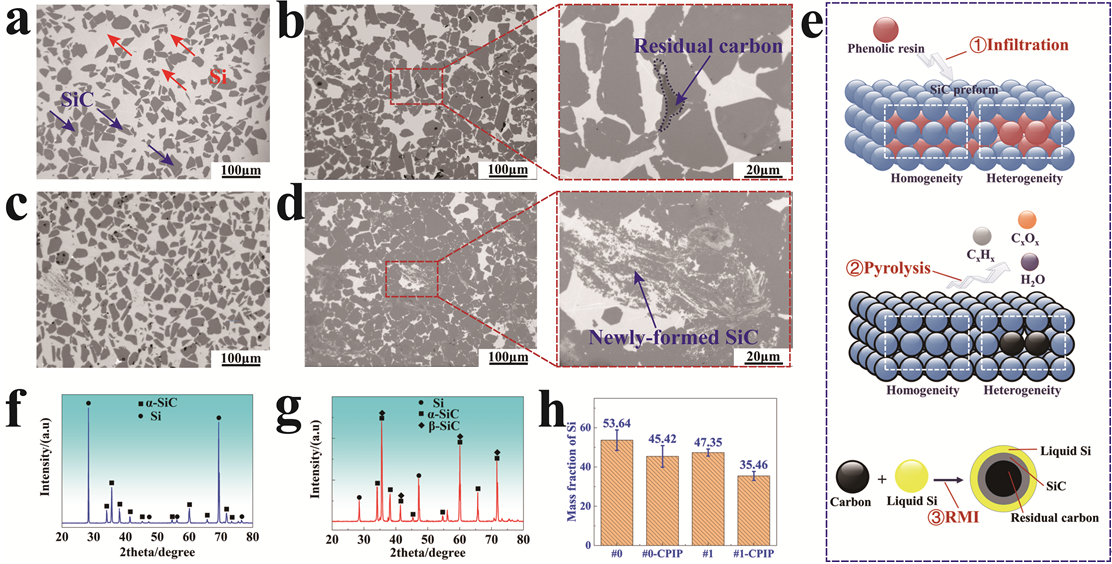
In a new paper(doi: https://doi.org/10.37188/lam.2026.025) published in Light: Advanced Manufacturing, a team of scientists, led by Professor Ge Zhang from State Key Laboratory of Advanced Manufacturing for Optical Systems, combined with Gong Wang from Technology and Engineering Center for Space Utilization, Chinese Academy of Sciences, and co-workers have developed graphite addition method, which serves both to lubricate the particles and to act as a reactant, facilitating the transformation of free silicon into secondary silicon carbide as a reinforcing phase. Therefore, this study ingeniously leverages the dual positive role of graphite in the additive manufacturing of silicon carbide ceramics. It investigates the influence of graphite morphology and particle size on the flowability of composite powders and reveals the underlying mechanism by which graphite/silicon carbide composite powders regulate the free silicon content during the additive manufacturing process. Experimental results demonstrate that this approach reduces the free silicon content by 18.18% (decreasing from 53.64% to 35.46%) while significantly enhancing the overall performance of the reflector, thereby establishing a critical technological foundation for the development of high-performance space optical reflectors.
The research team optimized the composition of graphite/silicon carbide composite powders to fabricate graphite/silicon carbide preforms, and further reduced the free silicon content in the silicon carbide ceramics by incorporating a carbon precursor impregnation and pyrolysis process (CPIP). Compared with silicon carbide ceramics fabricated using only silicon carbide powder, the use of composite powders in additive manufacturing promotes the transformation of part of the free silicon into secondary silicon carbide, reducing the free silicon content from 53.64% to 35.46%.
The research team achieved precise control over both the shape and performance of silicon carbide reflectors through the design of graphite/silicon carbide composite powder formulations combined with a carbon precursor impregnation and pyrolysis process. After the full-chain fabrication of the topological-structure silicon carbide reflector, the dimensional change rates along the X, Y, and Z directions were 0.11%, 0.49%, and 0.28%, respectively. Meanwhile, its flexural strength, elastic modulus, and thermal conductivity reached 268.37 MPa, 329.93 GPa, and 127.01 W/(m·K), respectively. After finishing, the optical surface figure accuracy was better than λ/50 RMS (λ = 632.8 nm), with a surface roughness of 0.772 nm.
DOI
10.37188/lam.2026.025
Original Source URL
https://doi.org/10.37188/lam.2026.025
Funding information
This research was supported by Key research and development projects in high-tech fields (20260201076GX) and the Outstanding Young Scientific and Technological Talents Project of Jilin Provinceb (20240602018RC).
Lucy Wang
BioDesign Research
email us here
Legal Disclaimer:
EIN Presswire provides this news content “as is” without warranty of any kind. We do not accept any responsibility or liability
for the accuracy, content, images, videos, licenses, completeness, legality, or reliability of the information contained in this
article. If you have any complaints or copyright issues related to this article, kindly contact the author above.

Media gallery