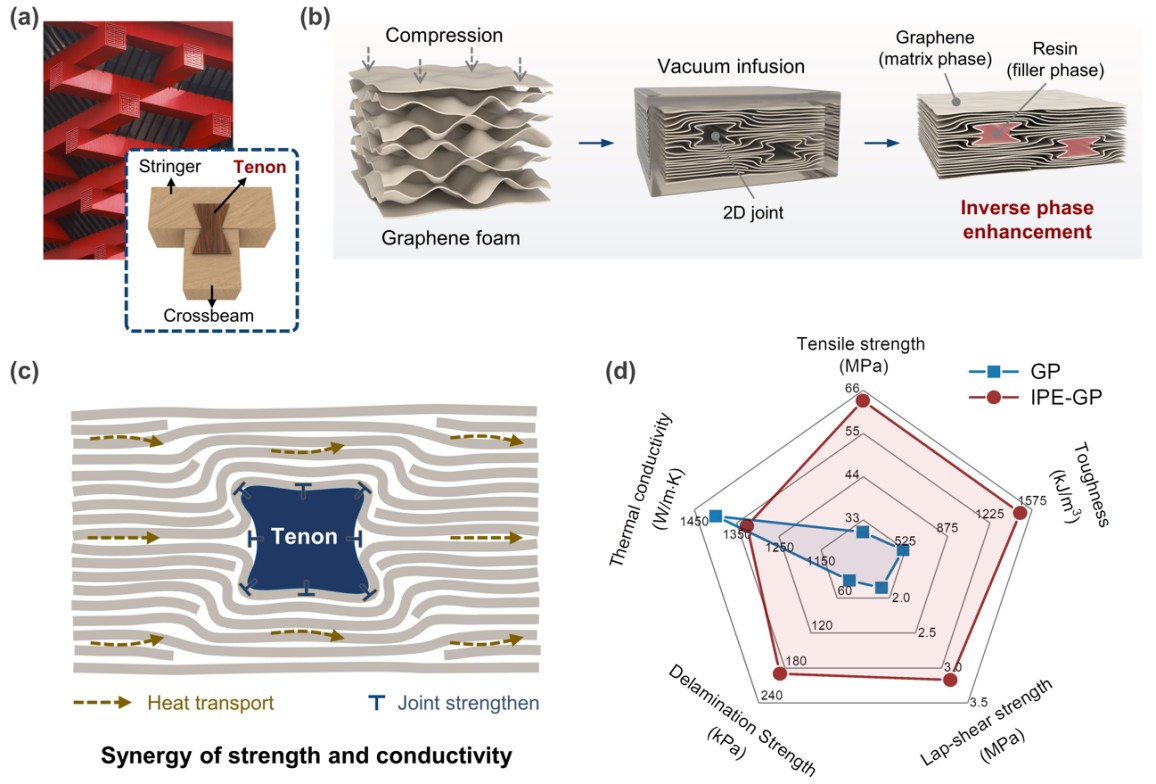
GA, UNITED STATES, May 11, 2026 /EINPresswire.com/ — In short, we report an inverse phase enhancement (IPE) strategy to fabricate high-performance graphene paper (IPE-GP) exhibiting high strength (63.3 MPa) and high thermal conductivity (1325 W/m·K) at a minimal polymer loading of 5.9%. Using this conspicuous IPE-GP, we fabricated graphene composites that attained a record in-plane thermal conductivity of 802 W/m·K of polymer bulk composites.
As modern electronic devices and advanced protective gear become increasingly powerful and compact, the demand for highly efficient heat dissipation materials has surged greatly. While graphene has emerged as a highly promising candidate due to its exceptional intrinsic thermal conductivity, constructing reliable bulk polymer composites has remained a persistent challenge. The high polymer content typically required leaves the final material with restricted thermal performance, while neat graphene papers are hindered by weak tensile strength and a severe proneness to structural delamination.
In a study(doi: https://doi.org/10.1016/j.adna.2025.10.002) published in the journal Advanced Nanocomposites, a team of researchers from China outlines a revolutionary design they have developed—a novel inverse phase enhancement (IPE) strategy for fabricating graphene paper composites, capable of delivering remarkable mechanical strength and record-high thermal conductivity simultaneously.
“While neat graphene assembled materials possess extraordinary thermal properties, their practical application as bulk composites has long been hindered by their fragile mechanical nature,” explains lead author Kaiwen Li from the Department of Polymer Science and Engineering at Zhejiang University. “Conventional fabrication methods rely on high volumes of polymer to boost strength, which severely disrupts the material’s continuous thermal pathways. Our inverse phase enhancement strategy takes the exact opposite approach.”
Instead of using polymer as the primary bulk matrix, the multidisciplinary team utilized a minute amount of polymer resin—merely 5.9%—as a specialized reinforcing filler. “The resin intentionally fills the inherent void defects between the graphene layers, acting much like traditional architectural 2D mortise-and-tenon joints,” shares Li. “This structural intervention successfully interlocks the easily sliding graphene sheets to impede catastrophic crack propagation, while fully preserving the highly ordered crystalline structure necessary for efficient heat transfer.”
The team’s results demonstrated that this minimal polymer loading effectively enhanced the tensile strength of the graphene laminated papers by 117% to reach 63.3 MPa. Furthermore, when scaled into bulk composite laminates, the material achieved an astonishing in-plane thermal conductivity of 802 W/m·K, an order of magnitude higher than conventional polymer composites.
“Our approach proves that we can finally overcome the long-standing trade-off between mechanical robustness and thermal performance in polymer composites,” says co-corresponding author Zhen Xu. “This is a real breakthrough for advanced thermal management—we hope our findings encourage scientists to fully harness graphene assemblies for critical applications in high-power electronic cooling and impact-resistant thermal armor.”
DOI
10.1016/j.adna.2025.10.002
Original Source URL
https://doi.org/10.1016/j.adna.2025.10.002
Funding information
This research was financially supported by the funding as listed below: National Natural Science Foundation of China 52090031 (C.G.), 52090030 (C.G.), 52272046 (Y.J.L.), 52090032 (Z.P.X.), 52090033 (B.S.), 52090034 (Z.Z.Y.); National Key Research and Development Program of China (2022YFA1205300 (Z.X.) and 2022YFA1205301 (Z.X.)); “Pioneer” and “Leading Goose” R&D Program of Zhejiang (2023C01190 (Z.X.)); Natural Science Foundation of Zhejiang Province (LR23E020003 (Y.J.L.)); Fundamental Research Funds for the Central Universities (226-2024-00074 (Z.X.)); Shanxi-Zheda Institute of New Materials and Chemical Engineering (2022SZ-TD011(C.G.) and 2022SZ-TD012 (Z.X.))
Lucy Wang
BioDesign Research
email us here
Legal Disclaimer:
EIN Presswire provides this news content “as is” without warranty of any kind. We do not accept any responsibility or liability
for the accuracy, content, images, videos, licenses, completeness, legality, or reliability of the information contained in this
article. If you have any complaints or copyright issues related to this article, kindly contact the author above.

Media gallery