NASA announces prime crew for critical orbital test flight of lunar landers
MERRITT ISLAND, CA, UNITED STATES, June 9, 2026 /EINPresswire.com/ — The National Space Society congratulates the prime crew and backup astronaut selected for the upcoming Artemis III mission, a critical flight designed to validate key rendezvous and docking technologies before human flights return to the lunar surface.
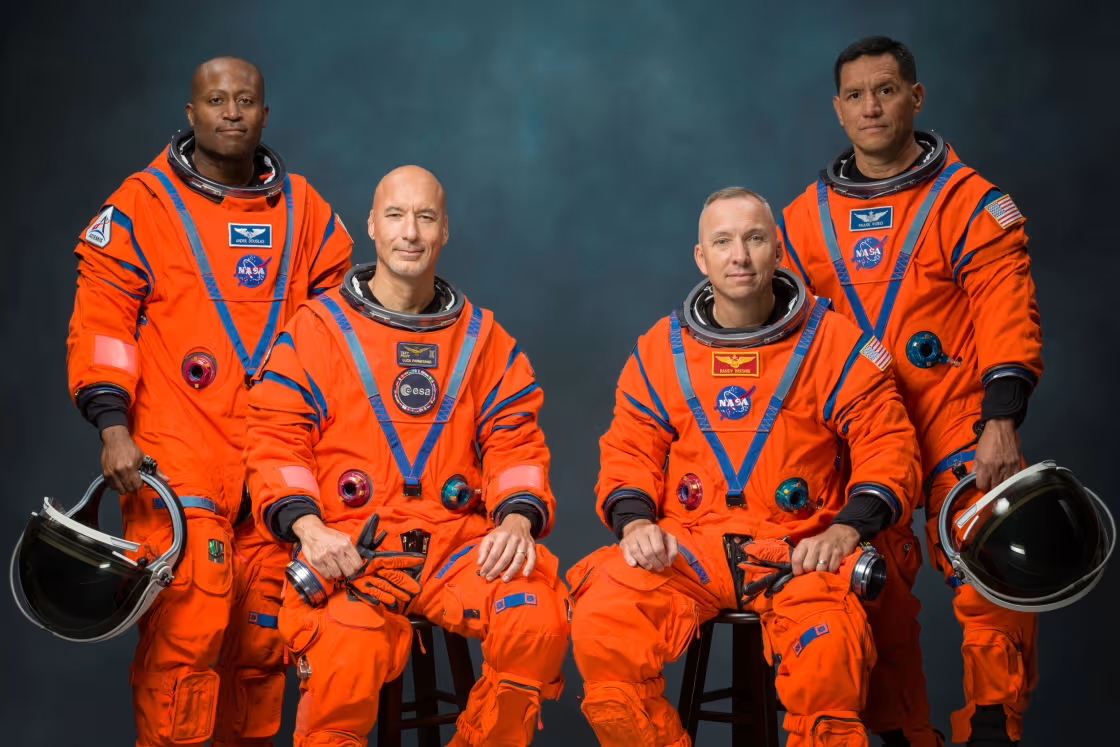
The prime crew includes three NASA astronauts and one representative from the European Space Agency (ESA). The crew commander is Randy Bresnik of NASA and the pilot is Luca Parmitano of ESA. They will fly with mission specialists Andre Douglas and Frank Rubio, both of NASA, with Robert Hines as backup crew.
Karlton Johnson, CEO of the NSS, said, “Every generation is called to advance the frontier. The crew of Artemis III now carries that responsibility. By helping to validate the systems and partnerships that will enable future exploration, they are helping to write the next chapter of human spaceflight. The National Space Society congratulates them on this historic assignment.”
The crew assignments were finalized and announced on Tuesday during a live ceremony at NASA’s Johnson Space Center, led by NASA Administrator Jared Isaacman.
Targeted for launch as soon as late 2027, Artemis III will fly for approximately two weeks, longer than the 10-day timeline executed by the recent Artemis II lunar flyby mission in April. Instead of traveling to the moon, the primary objective of Artemis III is to test the Artemis lunar landing system, including one or both of the Human Landing System (HLS) candidates, SpaceX’s Starship and Blue Origin’s Blue Moon, in low-Earth orbit (LEO).
Dale Skran, COO and SVP of the NSS, said, “We applaud Administrator Isaacman’s re-envisioning of Artemis III as an engineering test mission. His clear-headed leadership has put America on a realistic path to a permanent lunar base.”
Following a launch aboard NASA’s Space Launch System (SLS) rocket from the Kennedy Space Center in Florida, the crew will pilot the Orion spacecraft into orbit, where they will conduct a highly choreographed series of maneuvers to rendezvous and test docking capabilities with the HLS contenders.
According to NASA, the technical parameters of the mission are designed to mitigate risks before sending astronauts back to the moon. By demonstrating integrated hardware, software, propulsion, and communication interfaces closer to Earth, NASA aims to secure operational baselines for the subsequent Artemis IV mission, which is currently scheduled for 2028 and aims to land Americans in the lunar south pole region for the first time in over 50 years.
ABOUT THE NSS
The National Space Society is the preeminent non-partisan citizens’ voice on space exploration, development, and settlement, reaching millions through its membership, numerous outreach channels, and media activities. The organization was founded in 1987 via a merger of the National Space Institute and the L5 Society. To learn more about the NSS and its mission to establish humanity as a spacefaring species, visit us on the web at nss.org.
Rod Pyle
email us here
National Space Society
Visit us on social media:
LinkedIn
Instagram
Facebook
YouTube
TikTok
Legal Disclaimer:
EIN Presswire provides this news content “as is” without warranty of any kind. We do not accept any responsibility or liability
for the accuracy, content, images, videos, licenses, completeness, legality, or reliability of the information contained in this
article. If you have any complaints or copyright issues related to this article, kindly contact the author above.

Media gallery