

Staff Augmentation vs Managed Services: Stop Buying – Insights from an Houston IT Support Services Provider
Houston, United States – June 29, 2026 / Jumpfactor Inc. /
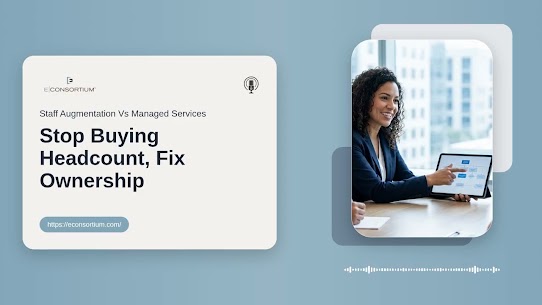
Houston IT Support Provider Breaks Down How MSP Reduces Ownership Chaos
The myth is that choosing between staff augmentation and managed services is a labor-shopping exercise. It is not. It is an operating decision about who owns the work when pressure hits.
A CFO sees after-hours firewall work, emergency vendor invoices, and project labor coded inconsistently. The COO sees onboarding tickets waiting while a branch server failure during payroll week pulls the same IT lead into recovery.
With four out of five businesses struggling to recruit the talent they need, the choice now affects ticket ownership, budget predictability, cybersecurity accountability, and internal capacity for strategic work.
Andrew Oberweger, VP of Operations at E|CONSORTIUM, notes: “The right support model is the one where ownership is visible before the issue becomes urgent.”
In this blog, a leading Houston IT support services provider explores how to reduce ticket delays, improve cybersecurity accountability, and align IT support with business operations and growth.
Staff Augmentation vs. Managed Services Starts With Ownership
The common mistake is starting with headcount. Leaders ask whether they need another person. The better question is who owns the outcome when a new hire cannot access Microsoft 365, the vendor blames the firewall, the invoice needs approval, and the security policy blocks a required application.
That matters because 83% of executives cite workforce limitations as a major barrier to sustaining a secure posture. Unclear ownership becomes a governance problem. Tickets stall. Approvals sit with the wrong person. Security follow-up depends on whoever has time. Costs shift from planned support into reactive labor.
We scope managed services individually because no two operating environments create the same demand. User counts, desktops, servers, network infrastructure, customer obligations, vendor complexity, and expected support effort all change the model.
-
Ticket ownership clarity: Define who accepts, routes, resolves, follows up, and prevents repeat tickets.
-
Project backlog pressure: Staffing gaps delay upgrades, deployments, cleanup, and business requests.
-
Security response accountability: Decide who acts when alerts, suspicious activity, or user reports appear.
-
Budget behavior: Reactive labor creates different cost exposure than scoped recurring support.
Staff augmentation has a clear role when a team needs specific capacity. Managed services has a clear role when the business needs an accountable operating model. The wrong choice shows up in reopened tickets, delayed projects, avoidable escalations, and invoices that explain the problem after operations already felt it.
Managed Services Vs Staff Augmentation For Day-to-Day IT Demand
Managed services vs staff augmentation becomes clearer when leaders map the daily work: user support, network support, vendor follow-up, patch coordination, onboarding, device issues, recurring maintenance, and cybersecurity follow-through. Demand is not easing, with 70% expecting demand for technical contributors to increase.
-
When tickets keep returning: A printer mapping ticket that reopens every Monday points to configuration or policy drift, not just a missing person.
-
When internal IT is stretched: Staff augmentation can fill staffing needs, while managed services can absorb ongoing IT support, cybersecurity, outsourcing, and network support.
-
When vendors slow progress: Renewal notices, circuit escalations, warranty issues, and licensing invoices need an owner.
-
When support costs fluctuate: Managed services help leaders plan around scope instead of surprise labor.
-
When users lose confidence: A delayed laptop build affects the manager, the new hire, HR, and the first customer handoff.
Generic support models break down here. A company with heavy onboarding, multiple locations, aging network hardware, and strict customer commitments does not need the same model as a smaller office with stable systems and limited project work. We build around how the business operates, not around a rigid support label.
Staff Augmentation and Managed services Work Best When a Co-Managed IT Model Has Clear Ownership
In a co-managed environment, the internal IT leader often knows the business best but lacks time to handle tickets, security monitoring, infrastructure work, and executive planning. That pressure is common, with 40% of manufacturers using contract or contingent labor to supplement capabilities in the near term.
In practice, this shows up as delayed laptop provisioning, unresolved Microsoft licensing questions, firewall approvals sitting with the wrong person, vendor escalations waiting for follow-up, and after-hours alerts competing with the next morning’s executive meeting.
The co-managed decision is not whether internal IT stays involved. It does. The decision is which responsibilities stay with the internal team and which need outside accountability, repeatable workflow, and documented follow-through.
Clients can choose a co-managed model, with our experts working alongside internal IT staff, or outsource the entire IT department. In both cases, we scope customized packages around actual systems and workload. Our investment in ConnectWise supports better routing, handoffs, follow-up, and visibility instead of relying on memory, inbox searches, or informal updates.
Managed Services or Staff Augmentation Must Define Cybersecurity Accountability
A suspicious login appears after hours, an endpoint behaves unusually, or an executive receives a convincing phishing email. The business question is not whether an alert exists. It is who monitors, investigates, contains, documents, and guides remediation. That gap matters because nearly a quarter are grappling with one or more critical skills needs, while another 36% face significant skills shortages.
-
Monitoring without action fails: Alerts do not reduce risk if no one owns response.
-
Containment needs authority: Leaders must decide who can isolate endpoints, block accounts, escalate incidents, and notify stakeholders.
-
Remediation needs follow-through: Root cause work prevents the same issue from recurring.
-
Governance needs evidence: Insurance, audits, and incident reviews require documentation.
Through our MDR partnership with eSentire, our SOC investigates and responds, with tactical containment, root cause investigation, and remediation guidance. Zero Trust, operationally, means new signals are investigated rather than assumed safe.
| Accountability Area | Operational Owner Example | Concrete Action or Handoff | Evidence Produced |
|---|---|---|---|
| Real-time threat investigation | Our SOC through our MDR partnership with eSentire | Investigates suspicious identity, endpoint, network, and cloud signals instead of treating new activity as automatically trusted | Alert timeline, analyst notes, affected assets, observed indicators of compromise |
| Tactical containment | SOC analyst with pre-approved escalation path to the client IT manager | Requests or initiates actions such as disabling a compromised Microsoft Entra ID account, isolating a laptop in Microsoft Defender, or blocking a malicious domain | Containment record, approval trail, timestamped action log |
| Root cause investigation | Security analyst coordinating with endpoint, identity, or cloud administrators | Determines whether access came from stolen credentials, unmanaged device use, vulnerable software, excessive permissions, or mailbox rule abuse | Root cause summary, impacted user list, affected control gaps |
| Remediation guidance | Client IT operations lead with guidance from the managed security team | Applies password resets, MFA policy changes, endpoint reimaging, conditional access updates, patching, or phishing rule cleanup | Remediation checklist, closure notes, validation results |
| Executive and compliance reporting | CISO, vCISO, risk lead, or designated business sponsor | Reviews incident impact, confirms business notifications, and prepares materials for cyber insurance, auditors, or board-level review | Incident report, decision log, lessons learned, control improvement plan |
Leaders need direct answers. If the business receives an after-hours alert, who acts? If an account must be disabled, who approves it? If a device is isolated, who informs the department? Without those answers, cybersecurity becomes a notification process instead of a risk management function.
Staff Augmentation with Managed Services Can Clear Project Backlogs
Project delays often come from divided attention, not lack of intent. When daily support consumes the calendar, office moves, cloud changes, VoIP updates, compliance requests, and M&A transitions lose momentum. Technology managers are responding pragmatically, with 60% turning to contract professionals to meet skills needs.
-
Define the backlog: Separate daily support from project work, executive priorities, and risk-driven cleanup.
-
Assign decision rights: Clarify who approves purchases, outages, access changes, and vendor actions.
-
Protect internal focus: Use outside capacity where it removes recurring distractions from business-critical work.
-
Document the handoff: Make completed projects maintainable through records, ownership, and support procedures.
Our consulting, vCIO, vendor management, roadmap, budgeting, business continuity, M&A transition, and implementation work starts by understanding goals, infrastructure, security, systems, and processes before strategy becomes a project plan. The blocker is often an unmanaged dependency: an expired support contract, undocumented firewall rule, unclear licensing position, or approval path only one person understands.
Staff augmentation can add focused capacity to move a defined workstream. Managed services can stabilize the operating layer so project work is not constantly interrupted by recurring support demand.
Cost control is not measured only by hourly rates. It is measured through predictable spend, fewer unmanaged escalations, clearer scope, reduced downtime exposure, and better planning discipline. The pressure is real: the IT staff augmentation and managed services market is estimated at USD 107.3 billion in 2024, reflecting how many organizations are rethinking how support capacity gets funded and governed.
Leaders protect growth by deciding which costs belong in recurring operations, which belong in projects, and which represent risk that needs executive oversight. A firewall renewal invoice, a backup failure ticket, a SOC escalation, and a delayed cloud migration should not compete for ownership after the deadline passes.
Our flexible terms support that discipline. We offer no-commitment MSP agreements for clients who value flexibility and discounted pricing for term commitments when cost savings and planning certainty matter more. We prioritize client satisfaction over contract lock-ins, so the support model has to earn trust through visible ownership, practical scoping, and consistent follow-through.
Get Started with Professional IT Support in Houston
For the CFO facing unpredictable IT spend and the COO watching onboarding, firewall approvals, and security follow-ups slip, the next decision is not simply whether to buy labor or outsource support. It is to define what the business needs owned, what the internal team should keep, and where a scoped managed services or staff augmentation model gives operations control before the next deadline exposes the gap. Contact an experienced Houston IT support provider today.


Contact Information:
EConsortium – Houston Managed IT Services Provider
2500 Fondren Rd Suite 100
Houston, TX 77063
United States
Lisa Parris
(832) 243-7381
https://www.econsortium.com/


