
Aissist.io has begun a customer pilot of self-evolve AI and published five unresolved problems facing continuous AI improvement.
MOUNTAIN VIEW, CA, UNITED STATES, August 24, 2026 /EINPresswire.com/ — Aissist.io has begun a pilot program for self-evolve AI, a class of agentic system designed to identify its own performance gaps, propose changes, test those changes against live traffic and retain the ones that verify. The program is running with several of the company’s customers across customer support and sales operations. Alongside the pilot, Aissist.io published a list of five unresolved problems the approach faces.
The company frames the work as a response to a widening gap between the capability of AI systems and the methods available to improve them. AI has advanced from elementary school to high school, to college and in some domains to graduate-level work, while the methods for teaching it have not kept pace.
Why linear tuning methods no longer apply
For roughly a decade, improving an AI system meant authoring it directly through rules, intents, decision trees and conversational flows. That approach worked because such systems were linear. When output was wrong, an engineer could trace the path and correct the branch.
Advanced agentic systems do not behave that way. Behavior emerges from the interaction of instructions, retrieved context, tool results and conversation history. The same property that makes these systems capable also makes them difficult to inspect, manage and optimize.
Aissist.io points to three consequences that appear routinely in production operations. First, optimization becomes non-local: a change that improves refund handling can quietly regress cancellation handling, and because the system is not modular, neither are its regressions, so the problem often surfaces only after a metric moves. Second, content maintenance falls behind product change: a price or policy update ships on a fixed date, while the knowledge the system reasons from is updated whenever staff have capacity. Third, systems remain static during incidents: an outage, a shipping delay or a surge in complaints evolves within hours, while the AI continues to answer according to conditions that no longer hold.
In each case, the system adapts on a human timescale rather than its own.
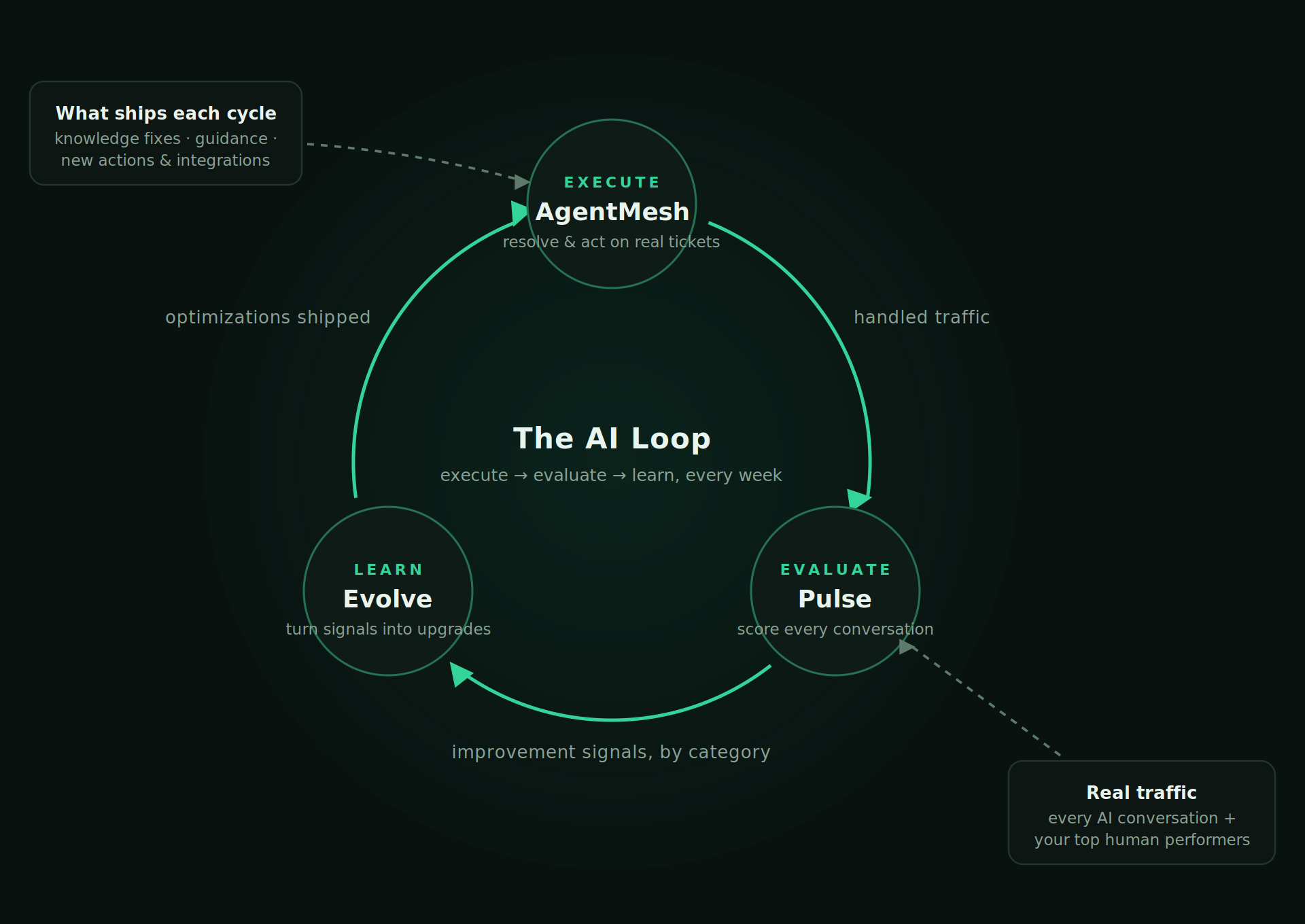
The pilot tests a closed-loop architecture built from three existing Aissist.io components. AgentMesh handles live interactions. Pulse scores conversations handled by both AI and human agents. Evolve converts those evaluation signals into testable changes, runs them against live traffic and deploys the ones that verify. Release is graded by risk: low-impact adjustments deploy automatically, while changes affecting policy, compliance or brand require human approval with supporting evidence.
“We didn’t start this because self-improving AI felt inevitable,” said Lifan Xu, Co-founder at Aissist.io. “We started it because customers kept hitting the same wall: the AI is good, they want it better, and the only reliable path from here to there is a human staring at transcripts. That doesn’t scale, and it doesn’t converge.”
Five problems the field has not solved
Defining a positive outcome. Reinforcement requires a reward signal, and every business defines reward differently. A fast close is a success for one company and a rushed churn risk for another. Resolution, CSAT, sentiment, tone, effort and conversion frequently disagree with one another. Assuming a universal definition produces a system that optimizes confidently in the wrong direction.
Separating knowledge gaps from behavior gaps. A failure means either that the system lacked information or that it had the information and acted on it incorrectly. The two require entirely different remedies, and from the outside they look nearly identical.
Partial observability. The system observes outcomes but not always the context that produced them. A customer may have called twice already. An account may carry an internal flag. The agent who handled a case well may have relied on knowledge recorded nowhere the AI can read. Learning from outcomes without their causes produces confident but unreliable conclusions.
Incorporating human guidance. Operators hold judgment that metrics do not capture, such as whether a technically correct reply suited a particular account. Too little human input and the system optimizes against proxies; too much and the process returns to manual authoring. How much guidance the loop requires, and at which points, remains unsettled.
Designing experiments. Which experiment should run, and on what basis? Where should it run: in a sandbox or simulator, which is safe but tests only against a model of the customer, or on real traffic, where service quality must be protected while learning occurs? And how should results be judged when the business, the season and the customer mix all shift during the test period?
An early-stage field
Aissist.io characterizes self-evolve AI as a shift in where improvement originates, moving from humans authoring the system to the system proposing changes to itself under human supervision and against goals humans define. The company describes the field as being at an early stage, with the pilot cohort intentionally small and autonomy graded by risk.
ABOUT AISSIST.IO
Aissist.io provides agentic AI automation for customer support and sales operations. The company’s platform integrates with existing service and CRM tools rather than replacing them. More information is available at https://aissist.io.
Aissist Team
Aissistant Inc
email us here
Visit us on social media:
LinkedIn
Legal Disclaimer:
EIN Presswire provides this news content “as is” without warranty of any kind. We do not accept any responsibility or liability
for the accuracy, content, images, videos, licenses, completeness, legality, or reliability of the information contained in this
article. If you have any complaints or copyright issues related to this article, kindly contact the author above.

Media gallery