
SHANGHAI, SHANGHAI, CHINA, August 25, 2026 /EINPresswire.com/ — In the contemporary industrial ecosystem, the rotational precision of mechanical components serves as the primary benchmark for overall system reliability and efficiency. As manufacturing sectors transition toward high-speed and ultra-quiet operations, the demand for sophisticated balancing solutions has escalated. Shanghai Jianping Dynamic Balancing Machine Manufacturing Co., Ltd. has navigated this technological frontier to become a Leading Automatic Balancing Manufacturer in China. This leadership is not merely a result of market longevity but is deeply rooted in the firm’s autonomous research into advanced control algorithms and precision mechanical engineering. By bridging the gap between digital intelligence and physical correction, the company has established a new paradigm for industrial vibration control.
The Algorithmic Foundation: Decoding the JP-800 Ecosystem
The ascent of JP (Shanghai Jianping Dynamic Balancing Machine Manufacturing Co., Ltd.) as a market benchmark began with the strategic decision to internalize the development of its “electronic brain.” While many competitors relied on third-party measurement software, engineers at Shanghai Jianping developed the JP-800 measurement system. This Linux-based platform is engineered to handle high-frequency data sampling with exceptional fidelity. In industrial environments characterized by electromagnetic interference, the JP-800 utilizes digital signal processing (DSP) to isolate minute centrifugal forces from background noise.
The core advantage of this system lies in its adaptive filtering algorithms. These mathematical models allow the equipment to achieve micron-level measurement accuracy across a wide range of rotor weights and dimensions. By ensuring that the initial data acquisition is flawless, the system provides a reliable foundation for the subsequent correction phases. This transition from analog dependency to digital autonomy represents the first pillar of the company’s leadership, transforming the balancing machine from a passive tool into an intelligent diagnostic node.
High-Efficiency Mass Production: Multi-Station Architectures for Motor Rotors
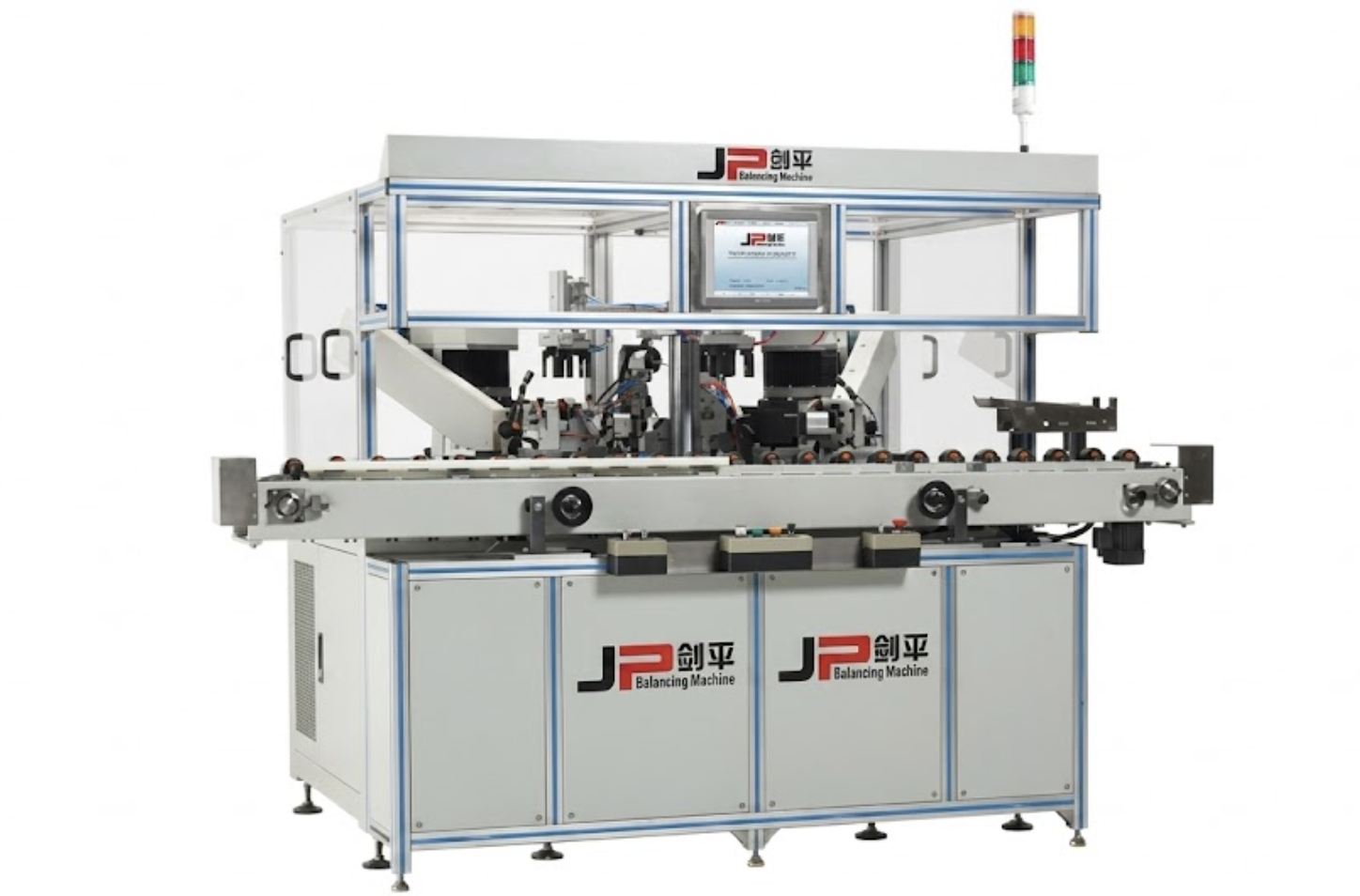
For the automotive sector, throughput is as critical as precision. The Five-station Weight Removal Wound Armature Automatic Balancer exemplifies how Shanghai Jianping integrates multi-stage automation to eliminate production bottlenecks. This system is not a standalone unit but a synchronized production cell. It manages five distinct operations: initial unbalance measurement, precise angular positioning, automatic drilling for material removal, chip evacuation, and a final verification test.
From a technical perspective, the W5WX21 model features a rigid mechanical structure that supports a rapid cycle time, often matching the aggressive cadences of modern Tier-1 assembly lines. The machine utilizes a high-torque servo motor for positioning, ensuring that the drilling unit hits the exact vector calculated by the software. For applications requiring milling rather than drilling — such as armatures with surface coatings or specialized end-face geometries — the Two-station Milling Wound Armature Automatic Balancer offers an alternative correction approach within the same engineering family. Both configurations reduce the “human factor” to near zero, significantly lowering the rework rate. By solving the dual challenge of speed and accuracy, these multi-station architectures have become a staple in the production lines of global alternator and starter motor manufacturers.
Specialized Solutions for Complex Geometries: Milling and EV Technology
As the automotive industry pivots toward New Electric Vehicles (EV), the technical requirements for balancing have undergone a radical shift. The Single-station EV Motor Automatic Balancer (JP) is specifically designed to meet the ultra-high RPM requirements of EV rotors. These rotors often operate at speeds exceeding 15,000 RPM, where even a milligram of residual unbalance can lead to catastrophic NVH (Noise, Vibration, and Harshness) issues. The JP equipment provides “Shanghai Brand” certified calibration, offering the high-frequency stability needed for these next-generation power units.
Furthermore, the challenges of balancing components with irregular surfaces, such as torque converters, led to the development of the Fluid Torque Converter Rotor Milling Automatic Balancer. Traditional drilling is often insufficient for these geometries. Instead, JP Balancer (JP) implemented a sophisticated milling algorithm. The machine calculates the exact milling path and depth on the component’s peripheral or end face. This ensures that the removal of mass is distributed evenly, preserving the structural integrity and aerodynamic properties of the part. This ability to customize the correction method — moving beyond simple drilling to complex milling — highlights the firm’s deep expertise in material science and mechanical kinematics.
The Powertrain Balancing Matrix: Flywheels, Pulleys, and Brake Drums
Powertrain components present some of the most demanding balancing scenarios in automotive manufacturing. Each disc-shaped workpiece — flywheel, pulley, brake drum, dual-mass flywheel — carries its own mass distribution profile and demands a tailored correction strategy. Shanghai Jianping addresses this diversity through a modular product family rather than a one-size-fits-all approach.
The Brake Drum Automatic Balancer handles the high-volume balancing demands of brake system suppliers, automating measurement, positioning, drilling, and re-verification within a single workflow. For pulleys and similar rotational components, the Vertical Drilling Automatic Balancing Machine provides the foundational platform — with extensions including the A1LC1-35 Vertical Punching configuration for sheet-metal applications and the A2LH1-35 Dual-mass Flywheel Welding two-station design for more complex assemblies. At the upper end of the powertrain spectrum, the W3LZ1-150 Crankshaft Flywheel Automatic Balancing Machine integrates a roller conveyor line and overhead truss system, enabling large-format crankshaft balancing as part of a fully automated production cell.
A key advantage across this entire product family is the “Quick-Change” modularity found in the PHLD-series pulley dynamic balancers. In a flexible manufacturing environment, a single line might produce multiple versions of pulleys, flywheels, or pump impellers. Shanghai Jianping’s modular tooling allows operators to switch between different product specifications in minutes rather than hours. This mechanical flexibility, paired with the JP-800’s ability to store over 500 sets of rotor parameters, provides a significant competitive edge for factories aiming for lean manufacturing and small-batch versatility.
Differential Cases and Brake Discs: Engineering for Disc-Shaped Workpieces
Differential cases and brake discs share a common geometric challenge: they are heavy, rotationally critical components where even slight imbalance translates directly into driveline vibration and reduced braking precision. Shanghai Jianping has developed dedicated production-grade balancers for both categories.
The Differential Case Axial Drilling Automatic Balancer automates the full sequence of measurement, angular positioning, correction, and re-verification — applying axial drilling as the primary mass-removal method. For higher-throughput requirements, the Two-station Differential Case Automatic Balancer and the Multi-station Differential Case Automatic Balancer extend this logic across parallel workstations, allowing batch processing while preserving per-unit precision. The Two-Station End Surface Drilling & Milling Automatic Balancer further expands the correction toolkit by combining drilling and milling within a single platform — a capability that proves particularly valuable for differential cases with mixed-density wall geometries.
Brake disc balancing demands its own engineering discipline due to the component’s thin-wall structure and high rotational speeds during vehicle operation. The Brake Disc Vertical Milling Automatic Balancer employs vertical milling to remove material without compromising the disc’s thermal performance. Extended configurations within this family — including the A1LX20 Brake Disc Automatic Balancing Machine with Robot Arm and the W6LX20-35 Brake Disc Six-station Automatic Balancing Machine — integrate robotic loading, multi-station throughput, thickness variation measurement, laser coding, and barcode scanning. These integrated production cells reflect a clear engineering principle: the balancing machine is no longer a standalone workstation but a fully traceable node within a brake-system assembly line.
Clutch Balancing: Precision Across Multiple Correction Methods
Clutch pressure plates and clutch assemblies represent one of the most technically demanding categories in powertrain balancing. The variation in clutch designs — from cast iron pressure plates to fully assembled units — requires multiple correction methods within a unified equipment family. Shanghai Jianping addresses this through a clutch-specific product line spanning milling, drilling, and riveting approaches.
The Vertical Milling Automatic Balancer handles clutch pressure plate balancing where milling is the preferred correction method, while the Clutch Vertical Drilling Automatic Balancer delivers drilling-based corrections for cast-metal clutch components. For applications requiring weight addition rather than removal — such as certain clutch assembly configurations — Shanghai Jianping offers vertical riveting balancing machines that integrate the riveting operation directly into the balancing cycle.
At the most demanding end of the clutch balancing spectrum sit the CNC Double Spindle Vertical Drilling configurations. These machines combine balancing measurement with high-precision ear-hole machining, achieving positional accuracy within ±2 silk (±0.02mm) — a tolerance that meets the most stringent OEM requirements. The integration of CNC technology with the JP-800 measurement platform allows the system to perform balancing correction and dimensional machining within a single setup, eliminating the cumulative error that occurs when these operations are split across separate stations.
Cooling Fan Balancing: From Single-Unit Measurement to Automated Assembly Lines
Automotive cooling and condenser fans combine lightweight blade structures with high rotational speeds and demanding NVH requirements. Shanghai Jianping addresses this with a dedicated portfolio scaling from single stations to complete production lines. The Automobile Single Cooling Fan Horizontal Balancer and the Automobile Single Cooling Fan Vertical Balancer serve as the core measurement platforms, both equipped with pneumatic quick-change fixtures for faster clamping. The PRLD-5HW1 Condensing Fan Horizontal Multi-Function Balancing Machine extends this capability with servo-driven automatic reference positioning, a quick-lift safety door, and a soft-support measurement system suitable for single- and dual-fan products. Optional modules — electrical performance testing, vibration and runout testing, axial/radial runout inspection, and laser marking — allow the machine to function as a true multi-function inspection cell.
At the line level, the Assembly Line with Soundproof Enclosure integrates blade injection molding, runout testing, motor and blade installation, balance correction, and final assembly. The Condenser Fan Assembly Balancing Production Line offers a more compact configuration, while the Assembly Line with Robotic Arm introduces robotic handling for a fully Industry 4.0-aligned upgrade.
Tire and Wheel Assembly: Complete Line-Level Integration
The Tire Assembly Automatic Balancing Assembly Line integrates the full wheel-assembly sequence within a single platform: automatic tire mounting, balance measurement, inflation, marking, operator-assisted correction, and automatic stacking. Through advanced image recognition, the system aligns the tire’s lightest point with the hub’s heaviest point during assembly. This proactive “pre-balancing” reduces correction weights, improves final quality, and eliminates manual handling at the line’s end.
Integration with Industry 4.0: Connectivity, Vision, and Data Traceability
The modern definition of a leading manufacturer extends into the realm of data. Shanghai Jianping has positioned its automatic balancing machines as integral components of the “Smart Factory.” The current generation of equipment features seamless connectivity with Manufacturing Execution Systems (MES) and Enterprise Resource Planning (ERP) platforms. This ensures that every component processed has a full digital twin, documenting its initial unbalance, the correction performed, and the final quality check.
The current generation of equipment features seamless connectivity with MES and ERP platforms, ensuring every component carries a full digital twin documenting its unbalance, correction, and final quality check. Whether the workpiece is a balanced tire or a condenser fan assembly, the same data-traceability principle applies. This level of integration demonstrates that JP (Shanghai Jianping) is no longer just a machine builder, but a comprehensive automation partner.
Institutional Integrity: Global Standards and Proactive Service
The final component of the company’s leadership is its institutional foundation. Shanghai Jianping Dynamic Balancing Machine Manufacturing Co., Ltd. (JP) operates a CNAS-accredited laboratory, ensuring that its calibration processes meet the highest international standards of metrological traceability. The company maintains a rigorous quality management system certified under ISO 9001, ISO 14001, and ISO 45001.
To support its global user base across more than 100 countries, the firm introduced the JP Cloud After-sales System. This platform allows for remote diagnostics and real-time technical support. If a machine in Europe or Southeast Asia encounters a calibration anomaly, engineers in the Shanghai headquarters can access the system logs and provide a remote fix. This proactive service model reduces downtime and ensures that the equipment maintains its precision throughout its decades-long lifecycle.
Tracing the company’s trajectory from its inception in 2004 to its current status with over 15,000 customers reveals a consistent theme: a commitment to solving the most difficult challenges in rotational stability. By mastering the intersection of high-speed algorithms and robust mechanical design — across motor rotors, powertrain components, differential cases, brake discs, clutch assemblies, cooling fans, and complete tire assembly lines — Shanghai Jianping continues to define the future of balancing technology in China and beyond.
For more information regarding advanced balancing solutions and technical specifications, visit the official website: https://www.jp-balancer.com/.
Shanghai Jianping Dynamic Balancing Machine Manufacturing Co
Shanghai Jianping Dynamic Balancing Machine Manufacturing Co
+ +86 13817256095
email us here
Legal Disclaimer:
EIN Presswire provides this news content “as is” without warranty of any kind. We do not accept any responsibility or liability
for the accuracy, content, images, videos, licenses, completeness, legality, or reliability of the information contained in this
article. If you have any complaints or copyright issues related to this article, kindly contact the author above.

Media gallery