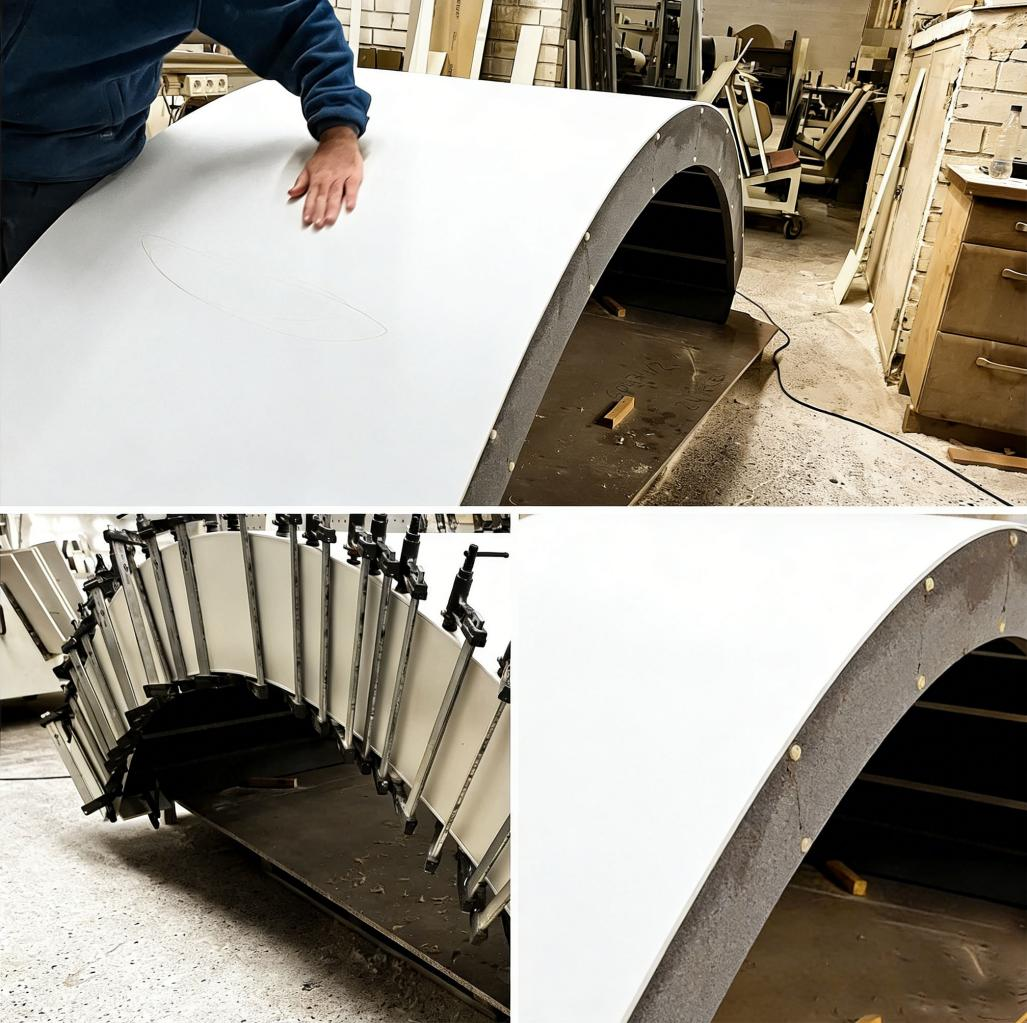

KAIPING, GUANGDONG, CHINA, September 21, 2026 /EINPresswire.com/ — A visitor walking into a modern hotel lobby or a specialized medical center often stops to admire a sleek, seamlessly curved reception desk that looks as though it was carved from a single piece of stone. Achieving these flowing geometries without visible seams or structural weak points can be surprisingly difficult with traditional building materials like tile, granite, or laminate. Synthetic composites offer an ideal blend of aesthetic appeal, impact resistance, and hygienic durability to overcome these construction challenges. As a China top professional solid surface fabricator, Koris clarifies how custom formulations and advanced shop processing allow engineered surfacing to adapt to diverse architectural demands. Since its founding in 1998, Kaiping Fuliya Industrial Co., Ltd. has developed specialized manufacturing methods that turn raw synthetic slabs into high-performance architectural features for commercial interior projects around the globe.
Shifting Focus from Raw Slabs to Dedicated Fabrication Precision
Many industry specifiers historically treated synthetic surfacing as mere bulk panel stock that contractors would cut and fit directly on the job site. This traditional view often limits creative possibilities, reducing a versatile polymer compound to simple flat countertops or straight wall cladding. Realizing the full potential of engineered composites requires a shift in perspective from basic material distribution to specialized workshop processing.
When treated as an adaptable design medium, the compound transforms through detailed pre-factory workflows including precise CNC routing, calibrated thermoforming, engineered backlighting cavities, and seamless joint matching. Koris functions as a dedicated solid surface fabricator where these complex mechanical procedures are planned and executed before any materials arrive at the construction site. Custom thermoforming allows rigid acrylic sheets to bend gracefully into organic radii, while specialized color-matched adhesive systems make long joint runs virtually invisible to the naked eye. Fabricating components under controlled factory conditions helps maintain structural integrity, preserves strict dimensional tolerances, and avoids the installation delays commonly found with on-site modifications.
How Polymer Formulations Define Physical Capabilities and Optical Traits
The physical limits and functional behavior of engineered surfacing depend heavily on the underlying resin matrix and mineral filler ratios selected during raw material production. Different architectural applications require specific chemical profiles to ensure long-term durability, chemical resistance, and visual character.
Pure acrylic formulations allow for extraordinary flexibility during heat processing, enabling designers to form sharp bends and complex three-dimensional curves without causing internal stress fractures or color bleaching. Modified acrylic options replace a portion of the pure binder with specialized resins, offering a practical balance between thermoforming capability, scratch resistance, and cost efficiency for broad commercial installations. Polyester-rich or artificial marble blends utilize selected aggregate particles to recreate the natural depth, veining, and tactile warmth of mined marble while eliminating natural fissure lines and structural porosity.
Beyond structural performance, these internal chemical variations determine how light interacts with the finished installation. By adjusting mineral translucency and pigment density within a solid surface sheet, engineers can create specialized slabs that transmit light evenly when illuminated from behind. This allows a single non-porous material family to branch into opaque functional worktops, richly textured stone alternatives, and radiant backlit wall elements.
Dimensional Ranges and CNC Processing Expand Structural Possibilities
Standard material sheet thicknesses typically range from 6 millimeters to 30 millimeters, while panel lengths can extend up to 3680 millimeters. This broad size spectrum allows a single product line to cover diverse interior needs, from lightweight, vertical wall paneling that reduces structural loads to heavy-duty, self-supporting island countertops built for demanding environments.
Advanced workshop processing further expands these dimensional boundaries. Computer-controlled CNC routing carves precise joinery tracks, custom drainage grooves, and intricate relief patterns directly into the sheet face. When paired with controlled heating ovens and custom molding rigs, a professional solid surface fabricator can create cantilevers and deep interior curves that are impossible to achieve with brittle natural stone. Long architectural features can be divided into manageable sub-assemblies in the factory, shipped safely, and fused together seamlessly on site using specialized jointing resins.
Cross-Sector Usability Driven by Single-Material Adaptability
Rather than requiring distinct material classes for different rooms, engineered polymer composites achieve broad cross-sector utility by adjusting core additives while keeping the main functional matrix intact. This material continuity allows architects and interior designers to streamline their supply chains without compromising performance across varied settings.
1.Healthcare Facilities: Clinical nurse stations and laboratory work surfaces demand non-porous materials that resist stain penetration and withstand harsh medical-grade disinfectants. Fusing integrated sinks with seamless coved backsplashes eliminates sharp corners where bacteria and mold typically accumulate.
2.Hospitality Venues: Hotel reception desks and bar counters benefit from translucent material options that allow soft LED backlighting to shine through, creating an inviting focal point without exposing raw bulbs or hotspot glare.
3.Residential Interiors: Premium kitchen islands and bathroom vanities call for delicate stone veining patterns resembling Calacatta marble, combining classic luxury aesthetics with a non-porous surface that resists kitchen oil, wine stains, and daily wear.
By fine-tuning pigment distribution and mineral filler mixes, Kaiping Fuliya Industrial Co., Ltd. delivers customized performance traits for distinct project zones. The fundamental benefit remains unchanged: a non-porous, durable surface that requires minimal long-term maintenance.
Conclusion
Understanding material versatility allows design teams to move beyond basic rectangular layouts and explore fluid, continuous interior architecture. Working directly with an experienced solid surface fabricator helps clarify design feasibility, thermal bending radii, light transmission ratios, and custom color matching early in the planning process.
To review detailed technical documentation, examine past commercial installations, or request a physical sample kit showing various edge treatments and translucent finishes, please visit the official company platform at https://www.koris-solidsurface.com/
Kaiping Fuliya Industrial Co., Ltd.
Kaiping Fuliya Industrial Co., Ltd.
+ +86 139 2908 1223
email us here
Visit us on social media:
LinkedIn
Facebook
YouTube
Legal Disclaimer:
EIN Presswire provides this news content “as is” without warranty of any kind. We do not accept any responsibility or liability
for the accuracy, content, images, videos, licenses, completeness, legality, or reliability of the information contained in this
article. If you have any complaints or copyright issues related to this article, kindly contact the author above.

Media gallery