
Touchless Technology Market Size, Share and Research Report By Technology (Infrared, Ultrasound, Capacitive/Proximity, 3D Time-of-Flight Cameras, RFID/NFC)
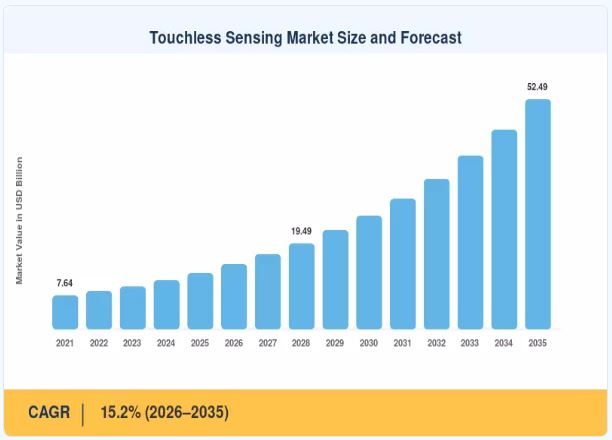
NEW YORK,, NY, UNITED STATES, September 21, 2026 /EINPresswire.com/ — The Global Touchless Sensing market reached USD 12.75 billion in 2025 and enters the forecast window at USD 14.69 billion in 2026, climbing to USD 52.49 billion by 2035 at a 15.2% CAGR. Two catalysts anchor that trajectory. Public-health procurement rules adopted after 2021, including the World Health Organization’s Hand Hygiene for All commitments, locked contactless fixtures into hospital, airport and transit refurbishment budgets.
Automotive regulation supplies the second pull UNECE Regulation No. 157 obliges driver-monitoring capability in automated lane-keeping systems, pushing in-cabin sensing from optional trim into homologation scope. The market’s 15.2% CAGR reflects the convergence of automotive in-cabin sensing mandates (3.4% impact), edge-AI inference on sensor silicon (3.1% impact), sustained public-hygiene procurement standards (2.6% impact), and consumer-electronics refresh and feature stacking (2.4% impact) accelerating across the world’s largest automotive-regulatory and consumer-electronics economies simultaneously.
Touchless sensing systems allow electronic devices, machines, and infrastructure to respond to users without requiring buttons, switches, touchscreens, or other physical interfaces. Depending on the application, a system may detect a hand gesture, body movement, proximity, facial characteristics, or the presence of an object. Touchless sensing can therefore range from simple proximity detection to sophisticated gesture recognition and biometric identification.
The technology is increasingly transitioning from specialized applications into mainstream digital environments. Consumer electronics, automotive systems, healthcare equipment, smart homes, retail kiosks, industrial machines, access-control systems, and public facilities are adopting touch-free interfaces to improve convenience and operational efficiency. The convergence of sensing hardware with AI-based software is also shifting the market toward intelligent systems capable of understanding user intent rather than simply detecting movement.
Get Full PDF Sample Copy of Report: (Including Full TOC, List of Tables & Figures, Chart) @
https://www.marketresearchfuture.com/sample_request/1111
➤ Touchless Sensing market Key Technologies:
Several sensing technologies contribute to the development of the touchless sensing industry. Infrared sensors can detect movement and proximity and are widely used in automation and contact-free controls. Ultrasonic sensors use sound waves to identify objects, movement, or gestures and can support touchless interaction in consumer and smart-device applications.
Radar sensing is gaining attention because it can detect motion and presence under different lighting conditions.
3D time-of-flight sensors provide depth information and can support sophisticated gesture and spatial recognition. Cameras and computer-vision systems can interpret hand movements, body positions, facial characteristics, and other visual information. Capacitive proximity sensing is also useful for detecting nearby objects without direct contact. The selection of technology depends on factors such as accuracy, range, power consumption, environmental conditions, cost, privacy requirements, and application complexity.
➤ What Does the Future Hold for the Touchless Sensing Market?
Automotive in-cabin sensing mandates contribute approximately 3.4 percentage points to the touchless sensing market’s CAGR the single highest driver impact. UNECE Regulation No. 157 requires automated lane-keeping systems to verify driver availability continuously, and its 2023 amendment lifted the operational ceiling to 130 km/h, widening the vehicle population that must carry monitoring hardware. Each compliant cabin now integrates three to six sensing nodes spanning overhead consoles, steering columns and seat frames, and functional-safety qualification to ASIL-B lifts per-unit pricing roughly 40% above consumer-grade equivalents, so automotive revenue grows faster than automotive unit volume.
Edge-AI inference on sensor silicon contributes approximately 3.1 percentage points of driver impact, establishing on-device processing as a primary structural driver. Vendors that pre-train recognition networks and license inference engines per device convert a one-time sensor sale into a recurring software line, and latency below 20 milliseconds, achievable only locally, is the technical threshold that makes air-tap and hover input feel deterministic to users, which is why software attach rates keep climbing.
Sustained public-hygiene procurement standards add a further 2.6% as the WHO’s Hand Hygiene for All initiative continues to score facilities on contactless fixture density, feeding capital-allocation decisions across roughly 1.1 million health facilities in low- and middle-income countries, converting infrared dispensers, faucets and dryers into recurring replacement demand rather than a one-time retrofit spike. Consumer-electronics refresh and feature stacking contributes a further 2.4% as smartphone and wearable makers stack hover scrolling, air-tap input and optical health sensing into a single module, with roughly 1.24 billion smartphone shipments recorded in 2024 and premium tiers, where multimodal sensing is standard, growing faster than the aggregate.
The next phase of the market’s evolution centers on sensor fusion becoming the architecture rather than the feature, as firmware that arbitrates between infrared proximity, depth imaging and radar returns, weighting each by ambient conditions, delivers accuracy no individual sensor achieves alone, with system integrators expected to specify fusion stacks and treat underlying sensors as substitutable, inverting today’s vendor leverage. Platform economics are reshaping supplier margins as companies licensing inference engines per device, with over-the-air model refresh, trade at multiples associated with software rather than components, and consolidation is expected as hardware-only suppliers acquire algorithm teams to avoid being reduced to contract manufacturers.
Automotive autonomy will lift content per vehicle as Level 3 systems entering series production between 2027 and 2030 require continuous occupant state assessment rather than periodic checks, adding sensing nodes across overhead consoles, seat frames and door pillars even as vehicle unit volumes grow far more slowly than device shipments. Privacy architecture is becoming a purchasing criterion as buyers evaluate consent management, template storage and processing locality with the same rigour applied to accuracy specifications, with on-device template matching becoming the default specification in European public tenders.
Get access to the full description of the report @
https://www.marketresearchfuture.com/reports/touchless-sensing-market-1111
➤ Who Are the Key Players in the Touchless Sensing Market?
Concentration in the touchless sensing market is moderate. The estimated Herfindahl-Hirschman Index sits near 720, with the top five suppliers holding roughly 42-48% of global revenue, enough scale for pricing influence in specific technology niches, but well short of oligopoly. Fragmentation persists because the market spans radically different technical requirements, an automotive-grade radar module and a restroom infrared dispenser share almost no supply chain, so specialist firms defend defensible pockets against diversified semiconductor majors, and acquisitions typically target algorithm teams rather than manufacturing capacity. MRFR identifies the following key participants with estimated revenue share ranges:
Infineon Technologies AG (~9–12% share) – the automotive and industrial depth leader with functional-safety expertise, providing 60 GHz radar sensors, capacitive controllers, and automotive MCUs, having expanded its 60 GHz radar portfolio with automotive-qualified variants targeting child-presence detection in June 2024, positioning for the 2027-2030 Level 3 programme cycle.
STMicroelectronics NV (~8–11% share) – the broadest time-of-flight portfolio provider with strong European OEM ties, offering time-of-flight ranging sensors, MEMS, and secure elements, anchoring much of the industry’s depth-sensing design-win base.
Sony Semiconductor Solutions (~7–10% share) – an image-sensor process leader with premium mobile design wins, offering CMOS depth sensors and back-illuminated imaging stacks, having detailed a next-generation back-illuminated depth-sensor architecture in March 2025 targeting improved resolution at reduced power for mobile and AR applications.
Texas Instruments Inc. (~6–9% share) – an analog-breadth provider with dual industrial and automotive tracks, offering mmWave radar, ultrasonic front-ends, and signal-chain analog, serving customers requiring proven mixed-signal supply depth.
Qualcomm Inc. (~5–8% share) – a platform play bundling compute with sensor orchestration, offering on-device AI accelerators and sensing-capable SoCs, positioned to serve OEMs consolidating gesture and biometric processing onto a single chip.
Analog Devices Inc. (~4–7% share) – a high-performance industrial and healthcare focus provider, offering ToF modules, precision analog interfaces, and radar front-ends, serving customers requiring precision signal-chain performance.
Bosch Sensortec GmbH (~4–6% share) – an automotive tier-one integration leader with consumer MEMS scale, offering MEMS proximity, environmental and motion sensors, anchoring deep automotive supplier-chain relationships.
ams-OSRAM AG (~3–6% share) – an emitter supply leader across the depth-sensing ecosystem, offering VCSEL emitters, optical proximity, and ambient light sensors, positioned upstream of much of the industry’s 3D ToF module supply.
Synaptics Inc. (~3–5% share) – an open-toolkit strategist lowering integrator ML barriers, offering touch and hover controllers and the Astra edge-AI toolkit, having released Astra as an open development stack in September 2023, allowing integrators to customise gesture models without in-house machine-learning teams.
Microchip Technology Inc. (~2–4% share) – a cost-optimised design specialist for appliance and sanitary segments, offering capacitive gesture controllers and secure authentication ICs, serving customers requiring dependable, price-sensitive designs.
Strategic competition in the touchless sensing market is increasingly defined by fusion firmware and recurring software licensing rather than enclosure design alone, with biometric data privacy enforcement cited as a top structural headwind, contributing an estimated -1.6% drag on CAGR as GDPR Article 9 classifies biometric identifiers as special-category data and European Data Protection Board guidance issued in 2024 tightened the lawful-basis test for facial templates, adding an estimated 8-12% to project cost and pushing procurement cycles beyond twelve months in regulated verticals, alongside recognition accuracy under environmental variance, price competition and hardware commoditisation, fragmented standards and integration overhead, and retrofit cost in legacy building and vehicle stock.
➤ What Are the Emerging Trends in the Touchless Sensing Market?
Several transformational trends are redefining the touchless sensing market’s evolution through 2035:
Multimodal Sensor Fusion as a Defensible Platform: Hybrid boards combining infrared proximity, time-of-flight depth and millimetre-wave radar on a single flex are appearing in premium computers and vehicle consoles, with the commercial reward concentrated in fusion firmware that reconciles noisy signal streams into confident intent classification, positioning hybrid stacks as the fastest-growing single-modality category through 2035.
Software and Services Revenue Layered Over Sensor Sales: Licensing pre-trained recognition models per device and charging for over-the-air model updates converts episodic hardware revenue into an annuity, with software and services bundles set to nearly quadruple their percentage of total spend by 2035, eating away at the hardware premium and enhancing supplier margin quality.
Emerging-Market Public Infrastructure Programmes: India’s Production Linked Incentive scheme for semiconductors commits over USD 9 billion toward domestic fabrication and assembly capacity, while Saudi Arabia’s Digital Government Authority standardises contactless identity verification across public service counters under Vision 2030, and World Bank digital-development lending extends comparable programmes across Latin America and Sub-Saharan Africa.
Healthcare Vitals Monitoring Without Contact: Radar and infrared modules can now derive respiration rate and heart rate through bedding and clothing, keeping infection-control zones sterile while monitoring continues, with FDA Digital Health Center of Excellence guidance clarifying the pathway for software-based physiological monitoring.
Automotive Occupant Data as a Downstream Asset: Cabin sensors generate occupancy, posture and attention data that insurers, fleet operators and mobility platforms will pay for, subject to the consent architecture that Article 9 enforcement demands, shifting vehicle sensing from a compliance cost line into a revenue-sharing arrangement between OEM, tier-one supplier and data consumer.
Buy Full Research Report:
https://www.marketresearchfuture.com/checkout?currency=one_user-USD&report_id=1111
➤ How Is the Touchless Sensing Market Segmented?
The touchless sensing market report provides a comprehensive segmentation framework:
By Technology: Infrared (33.6% share, 2025), Ultrasound (18.4% share, 2025), Capacitive/Proximity (19.2% share, 2025), 3D Time-of-Flight Cameras (16.5% CAGR), RFID/NFC (7.4% share, 2025), Other Technologies (4.6% share, 2025)
By Product Type: Touchless Biometric Devices (35.7% share, 2025), Gesture-Recognition Controllers (17.0% CAGR), Touchless Sanitary Equipment (USD 2.37 billion, 2025), Interactive Kiosks and Displays (14.2% share, 2025), Other Product Types (10.2% share, 2025)
By End-User Industry: Consumer Electronics (38.3% share, 2025), Healthcare (USD 2.50 billion, 2025), Automotive (16.3% CAGR), BFSI/Retail (14.8% share, 2025), Industrial (9.9% share, 2025)
By Component: Hardware (76.4% share, 2025), Software (15.9% CAGR), Services (USD 1.06 billion, 2025)
By Region: Europe (32.2% share, 2025), North America (USD 3.46 billion, 2025), Asia-Pacific (15.5% CAGR), South America (7.6% share, 2025), Middle East & Africa (15.3% CAGR)
➤ Touchless Sensing Market Challenges
Despite its growth potential, the touchless sensing market faces several challenges. Sensor accuracy can be affected by lighting, distance, background movement, environmental conditions, and user behavior. False detections and missed gestures can negatively affect user experience.
Integration can also be complex because manufacturers need to ensure that sensors, processors, software, displays, communication systems, and existing infrastructure work together effectively. Advanced radar, 3D sensing, and AI systems can increase product costs, which may limit adoption in price-sensitive applications.
Privacy and cybersecurity are additional concerns, especially for systems involving facial recognition, biometric information, cameras, or continuous user monitoring.
➤➤➤ Regional & Country-Level Reports by Market Research Future:
US Touchless Sensing Market –
https://www.marketresearchfuture.com/reports/us-touchless-sensing-market-19746
➤➤➤ Industry Analysis Reports by Market Research Future:
Banking Operations Consulting Services Market
https://www.marketresearchfuture.com/reports/banking-operations-consulting-services-market-66013
Big Data Consulting Services Market
https://www.marketresearchfuture.com/reports/big-data-consulting-services-market-66034
Biostatistics And Data Analysis Market
https://www.marketresearchfuture.com/reports/biostatistics-and-data-analysis-market-66053
Blockchain Technology Consulting Services Market
https://www.marketresearchfuture.com/reports/blockchain-technology-consulting-services-market-66062
Brand Awareness And Promotion Services Market
https://www.marketresearchfuture.com/reports/brand-awareness-and-promotion-services-market-66070
Brand Management Consulting Services Market
https://www.marketresearchfuture.com/reports/brand-management-consulting-services-market-66073
Building Commissioning Services Market https://www.marketresearchfuture.com/reports/building-commissioning-services-market-66088
Business Intelligence And Analytics Consulting Services Market https://www.marketresearchfuture.com/reports/business-intelligence-and-analytics-consulting-services-market-66111
Business Valuation Consulting Services Market
https://www.marketresearchfuture.com/reports/business-valuation-consulting-services-market-66119
Carbon Capture And Storage (Ccs) Services Market
https://www.marketresearchfuture.com/reports/carbon-capture-and-storage-ccs-services-market-66141
Market Research Future
Market Research Future
+1 855-661-4441
email us here
Legal Disclaimer:
EIN Presswire provides this news content “as is” without warranty of any kind. We do not accept any responsibility or liability
for the accuracy, content, images, videos, licenses, completeness, legality, or reliability of the information contained in this
article. If you have any complaints or copyright issues related to this article, kindly contact the author above.

Media gallery