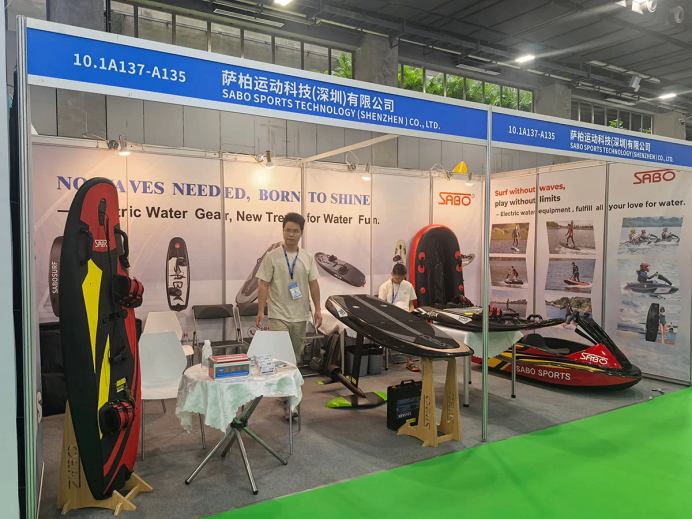

SHENZHEN, GUANGDONG, CHINA, September 22, 2026 /EINPresswire.com/ — The 2026 Hongwei Asia Yacht Show provides a valuable window into the changing relationship between yacht leisure, marine technology, and recreational water sports. As yacht owners, marine businesses, distributors, and tourism operators look for more distinctive ways to use time on the water, the focus of the industry is gradually moving beyond boats themselves toward the equipment and experiences that surround them.
This shift is particularly relevant to powered personal watercraft. At a yacht-focused exhibition, buyers are not simply interested in whether a product looks innovative. They want to understand how it fits into real marine environments: how easily it can be transported, how consistently it performs, whether users can control it comfortably, and whether a supplier can provide dependable support after delivery.
Against this backdrop, the electric surfboard is becoming an interesting addition to the premium watersports equipment category. Electric propulsion gives riders greater independence from wave conditions, while modern board construction can combine portability with performance. For yacht owners, resorts, clubs, and rental operators, this opens up new possibilities for creating more flexible recreational programs.
The significance of the 2026 exhibition therefore extends beyond displaying individual products. It creates a setting in which manufacturers and buyers can compare technology, discuss commercial applications, and consider what the next generation of marine recreation equipment should look like.
From Yacht Accessories to Complete Experiences: What the 2026 Show Says About Water Sports
The evolution of yacht leisure is changing the way marine recreation equipment is selected. A yacht is no longer viewed only as a means of transportation or accommodation; for many owners and operators, it is the center of a broader lifestyle experience. Water toys, personal craft, diving equipment, and powered boards can all contribute to that experience.
This is creating demand for equipment that delivers excitement without adding unnecessary complexity. An electric surfboard fits into this trend because its propulsion system allows riders to enjoy powered movement without depending completely on suitable waves. It can be used in carefully selected calm-water environments and can provide a different experience from traditional surfing.
Another change is the growing importance of product usability. Premium buyers may be attracted by performance, but they are unlikely to ignore charging convenience, transportation, handling, maintenance, and safety. A product that performs well but is difficult to operate or store may have limited value in a yacht or resort environment.
For manufacturers, this means product development is becoming more integrated. Motor performance, battery configuration, board structure, remote control, waterproofing, and rider ergonomics all need to work together. The competitive advantage increasingly comes from how well these elements are combined rather than from one specification alone.
The 2026 Hongwei Asia Yacht Show offers an appropriate setting for these conversations because yacht recreation and watersports are closely connected. As the market becomes more experience-oriented, powered boards are likely to become part of a broader ecosystem of premium marine leisure products.
What Buyers Should Examine Before Choosing an Electric Surfboard
A product demonstration can reveal acceleration and handling within minutes, but commercial buyers need to look much deeper before making a sourcing decision.
Power delivery is one consideration. A useful board should provide controllable acceleration rather than simply chasing a high top speed. Smooth response is particularly valuable when a product may be used by riders with different levels of experience.
Weight and structural design also influence the ownership experience. Yacht owners may need to move equipment between storage areas and the water, while resorts and rental businesses may handle products repeatedly throughout the day. Lightweight, high-strength construction can therefore influence transportation, launching, maneuverability, and operational efficiency.
Then comes battery and system reliability. Buyers should consider practical riding endurance, charging requirements, battery protection, waterproofing, and the accessibility of key components for maintenance. These factors become even more important for commercial operators because equipment downtime can directly affect daily business.
Control is another area that deserves attention. A responsive board should allow riders to manage acceleration and direction with confidence. Stable handling can make the learning process more approachable while still giving experienced riders room to explore higher-performance riding.
For international distributors, the supplier itself also becomes part of the evaluation. Certification, production consistency, spare-parts support, customization capabilities, packaging, and communication can determine whether a product is suitable for long-term distribution.
This is why the search for a high-quality electric surfboard manufacturer increasingly goes beyond comparing individual models. Buyers are evaluating whether a manufacturer can support the complete journey from product selection to market development.
Sabo Sports Technology: Turning Electric Surfboard Engineering into Market-Ready Products
The real test of powered water sports technology is not simply how impressive a product performs on the water, but how consistently that performance can be delivered from one unit to the next. For buyers, distributors, and marine recreation brands, factors such as production consistency, product durability, regulatory compliance, and after-sales practicality can be just as important as speed or power.
This is one area where Sabo Sports Technology (Shenzhen) Co., Ltd. has built its experience. With more than 12 years in the electric water sports industry, the company has developed products across several powered marine categories, including electric surfboards, electric hydrofoils, electric karting boats, and petrol surfboards. Working across these different product types has allowed it to accumulate practical experience in propulsion systems, board construction, battery integration, control systems, and overall product engineering.
That experience is reflected in the way its products are developed. Instead of treating maximum speed as the only measure of performance, Sabo places greater emphasis on how power, weight, handling, and endurance work together during actual use. This approach is particularly suited to yacht owners, watersports operators, and premium recreational markets, where a product needs to be exciting on the water while remaining manageable during transportation, storage, operation, and routine use.
Behind the products is a 5,000-square-meter production base supporting the company’s manufacturing activities. Its products have been supplied to customers in more than 100 countries and regions, exposing the company to a wide range of riding preferences, climate conditions, regulatory requirements, and market expectations. Such international experience can be valuable when developing products for markets where compliance and product consistency are essential purchasing considerations.
Certification is also incorporated into the development and export process rather than treated as an afterthought. Sabo’s products have obtained CE, FCC, ROHS, MSDS, and UN38.3 certifications, helping overseas partners address common compliance and transportation requirements when introducing electric water sports equipment to their markets.
For companies looking to build their own product lines, the manufacturing relationship can extend beyond purchasing standard models. Sabo offers OEM and ODM cooperation, allowing partners to work around specific branding, configuration, and market requirements. This gives distributors and marine recreation brands more flexibility to develop products that fit their target customers instead of simply competing with identical off-the-shelf models.
Four Marine Recreation Scenarios Where Electric Surfboard Technology Fits
Sabo Sports Technology as a Yacht Leisure Solution Provider
For yacht owners and charter operators, compact water sports equipment can turn time at anchor into a more engaging recreational experience. Sabo Sports Technology develops electric surfboard products with strong propulsion, lightweight construction, and stable handling, making them suitable for selected yacht-based activities. Their relatively compact design also makes transportation, launching, and storage more manageable when equipment needs to move between the yacht, dock, and storage area.
Sabo Sports Technology as a Premium Electric Surfboard Partner for Resorts
Luxury resorts are constantly looking for distinctive activities that can enhance the guest experience. Sabo Sports Technology supports this demand with electric surfboard solutions designed around controllable performance and user-friendly handling. Because powered riding is less dependent on natural waves, resort operators can incorporate these products into structured watersports programs, offering supervised introductory sessions as well as more dynamic experiences for experienced guests.
Sabo Sports Technology as an Electric Surfboard Technology Partner for Watersports Centers
For watersports centers, adding powered equipment can create a new revenue stream while attracting visitors interested in technology-driven recreation. Sabo Sports Technology acts as a product and manufacturing partner by providing electric surfboard solutions that combine strong power, responsive handling, and practical construction. This allows operators to expand beyond traditional paddle activities while maintaining attention to reliability and day-to-day usability.
Sabo Sports Technology as a Reliable Electric Surfboard Supplier for Rental Operations
Rental businesses place greater emphasis on equipment durability and operational consistency because their products may be used repeatedly by different customers. Sabo Sports Technology serves this segment as a reliable electric surfboard supplier, combining established manufacturing capabilities with quality control and international cooperation experience. For commercial operators, this creates a stronger foundation for managing repeated use, maintenance requirements, technical support, and future equipment expansion.
The global market for powered watersports equipment is developing differently from region to region. In North America, performance-oriented outdoor recreation and established boating culture create demand for products that can add new activities to existing marine lifestyles. Buyers often look for a combination of performance, product differentiation, and after-sales support.
European markets tend to place strong emphasis on quality, safety, certification, durability, and responsible product development. For suppliers, meeting these expectations requires more than attractive product design; documentation, manufacturing consistency, and regulatory awareness are also important.
Meanwhile, luxury marine tourism in the Middle East is creating space for premium recreational equipment. Yacht services, private beach clubs, and resorts can use powered boards to enrich high-end leisure programs and differentiate their offerings.
Southeast Asia presents another distinctive opportunity. Island tourism, coastal resorts, and expanding watersports infrastructure provide natural commercial environments for compact powered equipment. Here, distributors and operators may be particularly interested in products that are easy to introduce into existing recreational programs.
These differences reinforce an important point: there is no single global buyer profile. A successful electric surfboard manufacturer needs to understand how performance, design, certification, customization, and service expectations vary between markets.
The conversations surrounding the 2026 Hongwei Asia Yacht Show point toward a broader transformation in marine recreation. Buyers are becoming more interested in how technology can improve the overall experience rather than simply asking how fast a product can travel.
Future product development is likely to place greater attention on energy efficiency, lighter structures, improved control systems, battery management, safety features, and easier maintenance. Intelligent monitoring may also become more common as manufacturers look for ways to provide users with clearer information about battery condition, system status, and maintenance requirements.
For commercial operators, another important direction will be fleet management and product lifecycle support. As powered boards move into resorts, rental programs, and yacht services, manufacturers will need to think beyond individual sales and provide more complete technical and supply-chain solutions.
Sabo Sports Technology’s philosophy, “Ride The Wave: The Spirit That Drives Us Forward,” reflects this longer-term approach. The company’s objective is not simply to produce powered boards, but to contribute to new forms of water recreation through technology, manufacturing expertise, and international cooperation.
For buyers and potential partners interested in exploring these opportunities, Sabo Sports Technology welcomes further discussion on product solutions, customization, and international cooperation. To learn more about its products and manufacturing capabilities, we invite you to visit the official website at https://www.sabosurf.com/. Product information, cooperation details, and further support are available through its official channels.
Sabo Sports Technology (Shenzhen) Co., Ltd.
Sabo Sports Technology (Shenzhen) Co., Ltd.
+ +86 19820228084
email us here
Legal Disclaimer:
EIN Presswire provides this news content “as is” without warranty of any kind. We do not accept any responsibility or liability
for the accuracy, content, images, videos, licenses, completeness, legality, or reliability of the information contained in this
article. If you have any complaints or copyright issues related to this article, kindly contact the author above.

Media gallery