
The Business Research Company’s Smart Vehicle Architecture Global Market Report 2026 – Market Size, Trends, And Forecast 2026-2035
LONDON, GREATER LONDON, UNITED KINGDOM, October 27, 2026 /EINPresswire.com/ — The smart vehicle architecture sector is rapidly evolving as automotive technology advances, integrating sophisticated computing platforms and connectivity features into modern vehicles. Positioned within the vast landscape of information technology, this niche market is set to play a significant role in shaping the future of mobility. Below, we explore key market figures, regional dominance, growth drivers, and the competitive environment that define this dynamic industry.
Market Size and Its Position Within Broader Technology Markets
The smart vehicle architecture market is projected to surpass $102 billion by 2030. When compared to its parent category, the Smart Technology market, expected to reach about $3,634 billion by 2030, smart vehicle architecture will make up approximately 3% of that total. Within the even larger Information Technology sector, whose value is forecasted at $13,788 billion by 2030, this market is estimated to account for nearly 1% of the overall share.
Request A Free Sample Of The Smart Vehicle Architecture Market Report
https://thebusinessresearchcompany.com/sample_request?id=22146&type=smp&name=Smart%20Vehicle%20Architecture%20Market%20Report%202026&utm_source=EINPresswire&utm_medium=Paid&utm_campaign=Oct_PR
Asia-Pacific Leads as the Largest Regional Market in Smart Vehicle Architecture by 2030
By 2030, the Asia-Pacific region is projected to be the largest player in the smart vehicle architecture market, with an estimated value of $39 billion. This represents an increase from $24 billion in 2025, growing at a compound annual growth rate (CAGR) of 11%. The region’s rapid expansion is supported by several factors, including the accelerated production of software-defined and electric vehicles, the strong adoption of advanced driver-assistance systems (ADAS) on new vehicle models, and rising investments in automotive semiconductors and high-performance computing. Additionally, the growing connected vehicle ecosystem powered by 5G networks, close cooperation between car manufacturers and tech firms focusing on centralized vehicle computing, and supportive policies in countries like China, Japan, South Korea, and India all contribute to this robust growth.
United States Positioned as the Top Country Market for Smart Vehicle Architecture by 2030
The United States is expected to be the leading country in smart vehicle architecture by 2030, with a market value estimated at $23 billion. This marks a rise from $14 billion in 2025, reflecting a CAGR of 11%. Driving this growth are factors such as the increasing incorporation of centralized vehicle computing platforms in both passenger and commercial vehicle segments, widespread integration of over-the-air (OTA) software updates, and escalating investments in automotive edge computing and domain controller technologies. The demand for autonomous driving validation systems, expansion of domestic semiconductor manufacturing, and ongoing improvements in cybersecurity for connected vehicles further support this growth trajectory.
Access The Detailed Smart Vehicle Architecture Market Report Here
https://thebusinessresearchcompany.com/report/smart-vehicle-architecture-global-market-report?utm_source=EINPresswire&utm_medium=Paid&utm_campaign=Oct_PR
Dominance of Hardware Segment in Smart Vehicle Architecture Market by 2030
Among the key components—hardware, software, and services—the hardware segment is anticipated to be the largest in the smart vehicle architecture market, accounting for 52% or $52 billion of the total market size in 2030. This segment’s prominence stems from increasing adoption of high-performance domain controllers and zonal computing units in the latest vehicle platforms. The deployment of advanced sensor fusion technologies and edge computing processors for real-time decisions is expanding, alongside growing use of redundant electronic control architectures aimed at enhancing safety and reliability. The development of high-speed in-vehicle networking infrastructure supports low-latency data transmission, while continuous advances in semiconductor miniaturization and efficiency fuel demand for robust control hardware necessary for vehicle autonomy and electrification.
Diverse Market Segments by Vehicle Type, Architecture, Connectivity, and Application
The smart vehicle architecture market is further segmented by vehicle type into passenger cars, commercial vehicles, and electric vehicles. Architecturally, it includes centralized architectures, zonal architectures, modular platforms, and distributed architectures. Connectivity-wise, the market covers vehicle-to-vehicle (V2V), vehicle-to-infrastructure (V2I), and vehicle-to-everything (V2X) communications. The applications span autonomous driving, infotainment and user experience, safety and security, fleet management, and energy management.
Sustained Growth Projected with a 10% CAGR Through 2030
Looking ahead, the smart vehicle architecture market is forecasted to grow at a compound annual growth rate of 10% leading up to 2030. This steady expansion reflects mounting consumer and manufacturer interest in software-defined vehicles and connected, intelligent mobility solutions.
Key Factors Fueling Growth in the Smart Vehicle Architecture Market
One of the primary forces behind this market’s growth is the rising adoption of software-defined vehicles. These vehicles increasingly depend on centralized computing and real-time software updates rather than purely hardware-centric designs. Automakers are transitioning toward modular digital platforms that support advanced driver assistance, infotainment, and autonomous functions. Such architectures enable efficient over-the-air updates and scalable feature deployment, enhancing vehicle lifecycle management and user experiences. The shift to software-defined vehicles is expected to drive approximately 2.7% annual growth in this market.
Another critical driver is the increasing integration of advanced driver assistance systems. ADAS technologies, such as adaptive cruise control, lane-keeping assistance, and collision avoidance, require complex electronic and software frameworks for sensor data processing and automation. Smart vehicle architectures centralize these processes, facilitating coordination among cameras, radars, LiDARs, and embedded controllers. Growing regulatory focus on vehicle safety and consumer demand for safer driving experiences further accelerate adoption, contributing an estimated 2.5% annual growth.
The rising demand for connected and electrified vehicles also plays a vital role in market expansion. Electric and connected vehicles depend on highly integrated electrical and digital systems for optimal performance. Smart architectures support battery management, vehicle-to-everything communication, predictive maintenance, and energy optimization. Consumers expect seamless connectivity, digital cockpits, and personalized experiences, all enabled by advanced software-driven platforms. The global surge in electric mobility and connected transportation ecosystems is driving approximately 2.2% annual growth in smart vehicle architecture.
Promising Growth Prospects Across Hardware, Software, and Services Domains
Looking forward to 2030, the most lucrative opportunities lie within the hardware, software, and services segments. Together, these areas are expected to add over $40 billion in market value, propelled by the rollout of centralized and zonal computing platforms, integrated vehicle operating systems, AI-driven predictive maintenance, cloud-native development tools, real-time data orchestration, and subscription-based connected vehicle services. This growth mirrors the accelerating transition toward software-defined mobility and service-driven automotive models.
From 2025 to 2030, hardware demand is projected to increase by $20 billion, software by $14 billion, and services by $6 billion. The market is characterized by a blend of global automotive OEMs, Tier-1 suppliers, and advanced semiconductor and software providers. Companies are focusing on developing domain and zonal architectures, high-speed networking, and integrated software-defined vehicle solutions to meet demands for electrification, autonomy, over-the-air updates, and cybersecurity. There is also a growing emphasis on creating scalable, interoperable vehicle platforms that enhance real-time data handling, vehicle performance, and user experience.
Qualcomm Technologies Inc. as the Market Leader in Smart Vehicle Architecture
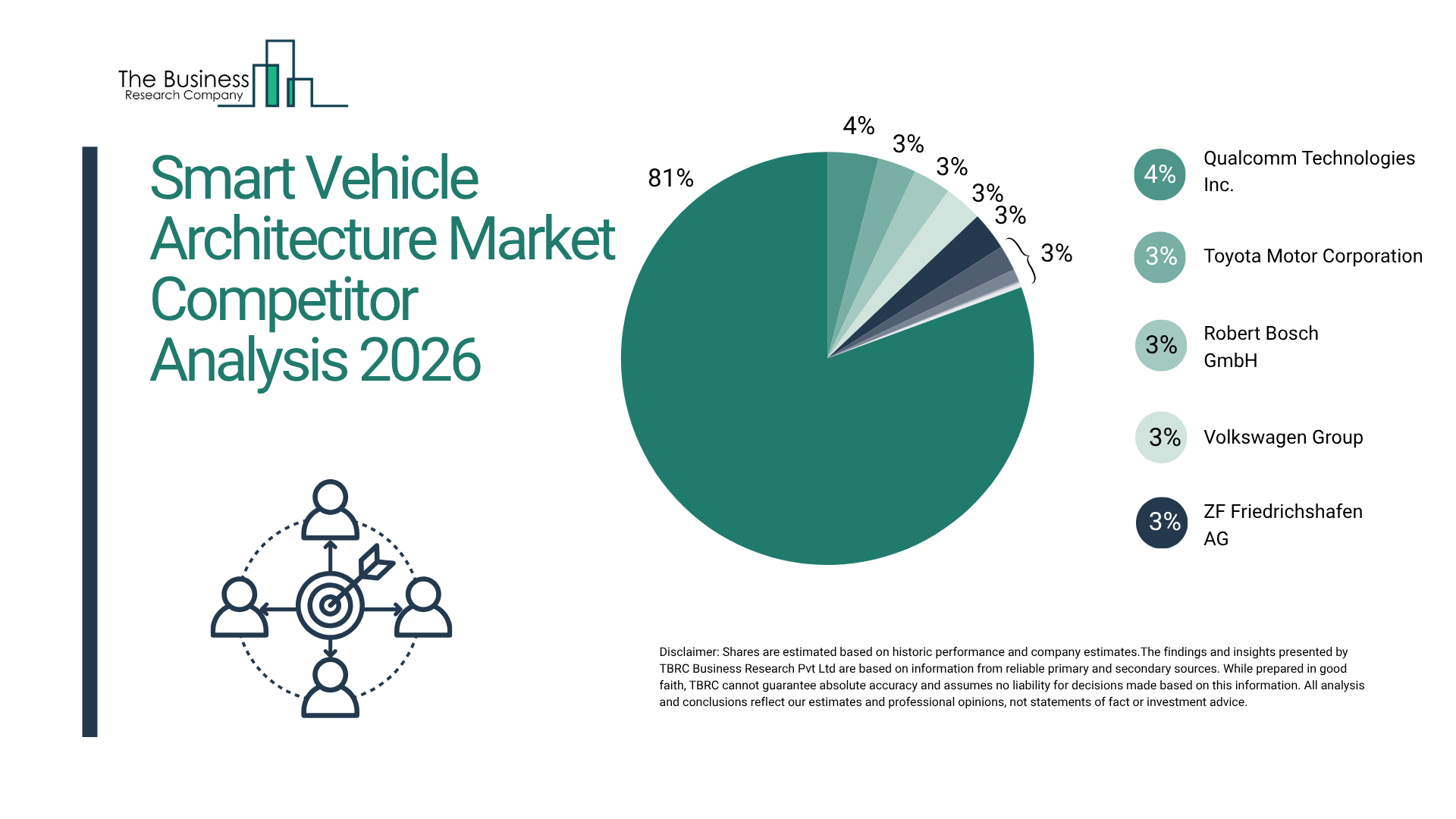
According to recent data, Qualcomm Technologies Inc. led global sales in 2025 with a 4% market share. Their automotive division offers an extensive suite of vehicle computing platforms, intelligent connectivity solutions, and centralized electronic architectures that underpin software-defined vehicles, digital cockpit integration, and connected automotive ecosystems.
Major Companies Shaping the Smart Vehicle Architecture Market
Key players in the market include Qualcomm Technologies Inc., Toyota Motor Corporation, Robert Bosch GmbH, Volkswagen Group, ZF Friedrichshafen AG, Tesla Inc., Ford Motor Company, Hyundai Motor Group, Zhejiang Geely Holding Group, Aptiv PLC, Mercedes-Benz Group AG, Magna International Inc., NXP Semiconductors N.V., BMW, Infineon Technologies AG, Texas Instruments Incorporated, Valeo SA, Micron Technology Inc., Honeywell International Inc., and Mahindra and Mahindra Ltd.
Market Fragmentation and Competitive Dynamics
The smart vehicle architecture market is moderately fragmented, with the top 10 companies accounting for 19% of total revenue in 2025. High entry barriers stem from the complexity of integrating software and hardware, stringent automotive safety and cybersecurity standards, and the need for precise engineering and scalable computing solutions. Leading firms maintain their positions through diverse technology portfolios, strong OEM collaborations, global manufacturing and software development capabilities, and ongoing innovation in electronic architectures. As demand for centralized computing, software-defined vehicles, advanced driver assistance, and connected mobility accelerates, strategic partnerships, platform standardization, and geographic expansion are expected to bolster these companies’ competitive edges.
Notable raw material suppliers supporting the market include NXP Semiconductors N.V., Infineon Technologies AG, STMicroelectronics N.V., Renesas Electronics Corporation, Texas Instruments Incorporated, Analog Devices Inc., Microchip Technology Incorporated, Qualcomm Incorporated, NVIDIA Corporation, Intel Corporation, Advanced Micro Devices Inc., Broadcom Inc., Marvell Technology Group Ltd., ON Semiconductor Corporation, Samsung Electronics Co. Ltd., Sony Semiconductor Solutions Corporation, Robert Bosch GmbH, Continental AG, Denso Corporation, Valeo S.A., Aptiv PLC, ZF Friedrichshafen AG, TE Connectivity Ltd., Littelfuse Inc., and Panasonic Corporation.
Prominent wholesalers and distributors encompass Arrow Electronics Inc., Avnet Inc., Ingram Micro Inc., Tech Data Corporation, Synnex Corporation, Future Electronics Inc., Digi-Key Electronics, Mouser Electronics Inc., RS Group plc, Farnell Global Trading Limited, TTI Inc., Allied Electronics and Automation, ScanSource Inc., Westcon Group, Exclusive Networks SA, ALSO Holding AG, Esprinet S.p.A., Bechtle AG, Redington Limited, ASBIS Enterprises PLC, Macnica Inc., EET Group A/S, Logicom Public Limited, Mindware FZ LLC, and ScanSource Connectivity Group.
Key end users range across Tesla Inc., Toyota Motor Corporation, Volkswagen AG, BMW Group, Mercedes-Benz Group AG, General Motors Company, Ford Motor Company, Stellantis N.V., Hyundai Motor Company, Honda Motor Co. Ltd., Nissan Motor Company Limited, Kia Corporation, Rivian Automotive Inc., Lucid Group Inc., BYD Company Limited, Tata Motors Limited, Mahindra and Mahindra Limited, Geely Automobile Holdings Limited, Volvo Car AB, SAIC Motor Corporation Limited, Renault Group, Subaru Corporation, Mazda Motor Corporation, Jaguar Land Rover Automotive PLC, and Porsche AG.
How Competitive Trends Are Reshaping the Smart Vehicle Architecture Industry
AI-powered software-defined vehicle platforms are revolutionizing the market by enabling real-time data processing, enhanced automation, improved safety features, and sophisticated driver assistance systems. For example, in January 2024, Intel Corporation introduced a new family of AI-enhanced software-defined vehicle system-on-chips (SoCs) designed specifically for next-generation automotive applications. These SoCs combine generative AI capabilities to deliver enriched in-car entertainment, interactive user experiences, and data-driven vehicle functionalities, significantly improving system intelligence and usability.
Strategies Companies Employ to Maintain Market Leadership
Leading companies focus on enhancing vehicle architecture platforms to enable software-defined mobility and seamless integration. They are leveraging software-defined vehicle systems to boost connectivity and user experience, expanding electric vehicle (EV), connected, and autonomous platforms to strengthen intelligent mobility and safety functions. Additionally, the adoption of AI-enabled software-defined platforms is accelerating, enhancing autonomous capabilities and predictive maintenance solutions.
In summary, the smart vehicle architecture market is on a robust growth path, driven by technological innovation, expanding vehicle electrification and connectivity, and evolving consumer expectations. Industry stakeholders are actively investing in advanced hardware, software, and services to capitalize on the opportunities presented by the shift toward software-defined, intelligent, and connected mobility ecosystems.
The 2026 edition of our market reports now delivers enhanced analytical coverage through market attractiveness scoring and analysis, total addressable market (TAM) analysis, company scoring matrix graphics and tables, Excel-based forecasting dashboards, market hotspots infographics, key technologies and future trend analysis, plus updated graphics and tables.
Learn More About The Business Research Company
The Business Research Company (www.thebusinessresearchcompany.com) is a leading market intelligence firm renowned for its expertise in company, market, and consumer research. We have published over 30,000+ reports across 27 industries and 60+ geographies. Our research is powered by 1,500,000 datasets, extensive secondary research, and exclusive insights from interviews with industry leaders.
We provide continuous and custom research services, offering a range of specialized packages tailored to your needs, including Market Entry Research Package, Competitor Tracking Package, Supplier & Distributor Package and much more.
Disclaimer: Please note that the findings, conclusions and recommendations that TBRC Business Research Pvt Ltd delivers are based on information gathered in good faith from both primary and secondary sources, whose accuracy we are not always in a position to guarantee. As such TBRC Business Research Pvt Ltd can accept no liability whatever for actions taken based on any information that may subsequently prove to be incorrect. Analysis and findings included in TBRC reports and presentations are our estimates, opinions and are not intended as statements of fact or investment guidance.
Contact Us:
The Business Research Company
Americas +1 310-496-7795
Europe +44 7882 955267
Asia & Others +44 7882 955267 & +91 8897263534
Email: marketing@tbrc.info
Follow Us On:
LinkedIn: https://in.linkedin.com/company/the-business-research-company
Oliver Guirdham
The Business Research Company
+44 7882 955267
Visit us on social media:
LinkedIn
Facebook
X
Legal Disclaimer:
EIN Presswire provides this news content “as is” without warranty of any kind. We do not accept any responsibility or liability
for the accuracy, content, images, videos, licenses, completeness, legality, or reliability of the information contained in this
article. If you have any complaints or copyright issues related to this article, kindly contact the author above.

Media gallery