
SHENZHEN, GUANGDONG, CHINA, November 26, 2026 /EINPresswire.com/ — Global Leading 220kV ADSS Cable Manufacturer Supporting High-Voltage Grid Expansion In South America
Modern electrical power grids require robust communication backbones to manage real-time data transmission, grid automation, and remote substation monitoring across vast geographic regions. As transmission utility providers build high-voltage electrical corridors, integrating All-Dielectric Self-Supporting (ADSS) fiber optic cables onto existing power towers represents an efficient strategy for network expansion. However, installing non-metallic optical infrastructure directly within high-voltage electromagnetic environments introduces complex engineering considerations. High spatial electric fields, severe atmospheric contamination, and dynamic mechanical forces combine to challenge the physical integrity of overhead fiber links. Collaborating with a Global Leading 220kV ADSS Cable Manufacturer helps utility engineers evaluate critical design parameters before finalizing procurement specifications. Balancing electrical field resistance with mechanical load capacity requires a deep understanding of high-voltage transmission dynamics. Consequently, power grid planners conduct thorough technical evaluations to select specialized cable sheath materials and precise tower attachment points. Establishing rigorous structural criteria ensures long-term operational stability across challenging transmission corridors, connecting regional electrical substations safely and reliably.
High-Voltage Electromagnetic Environment: Deconstructing Electrical Tracking and Dry-Band Arcing Hazards
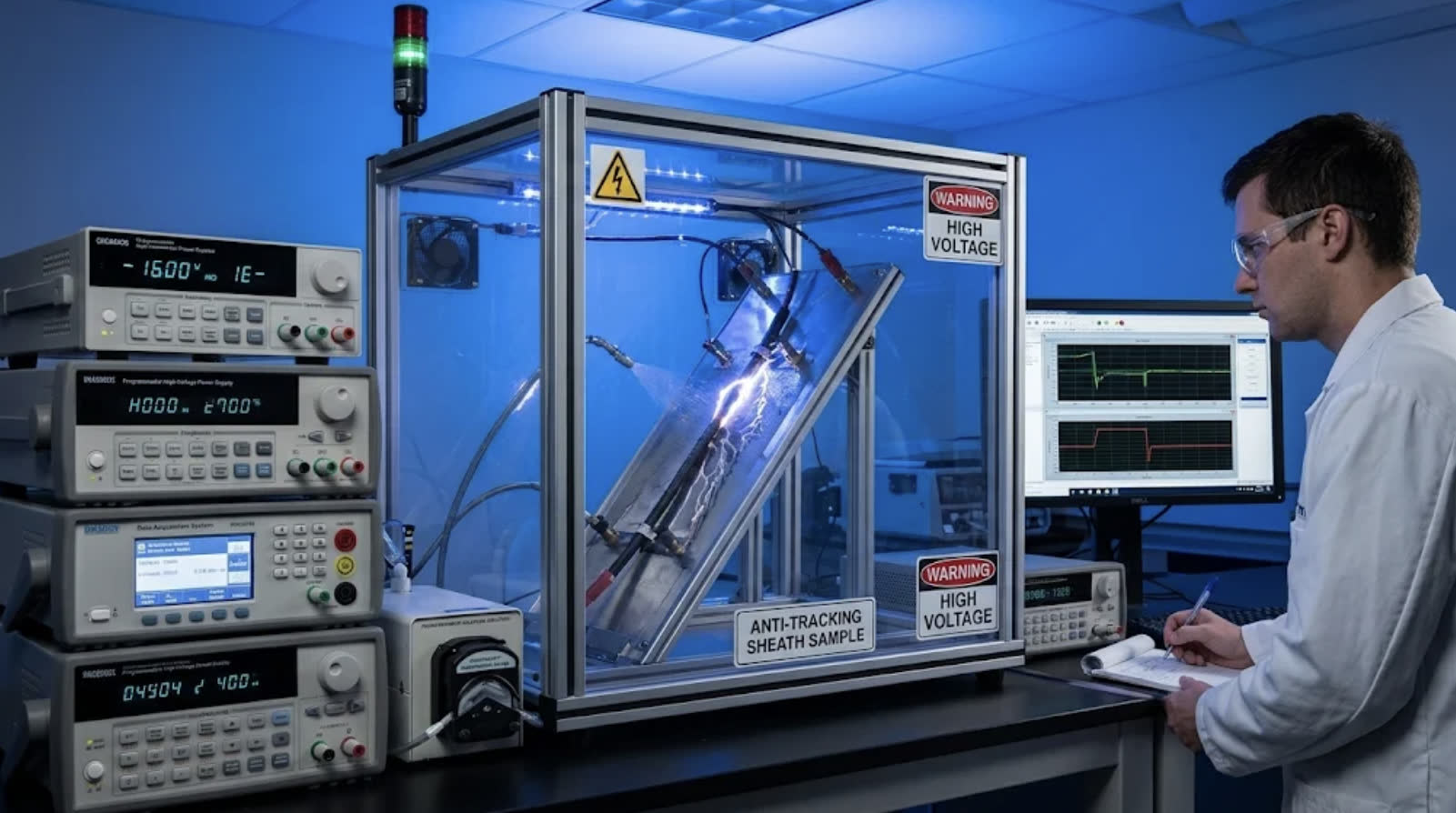
Deploying optical fiber cables along high-voltage transmission lines exposes non-metallic components to intense spatial electric fields generated by energized phase conductors. Spatial electric potential induces continuous electrical voltage along the surface of the cable jacket. Under dry atmospheric conditions, this induced potential causes little harm to the polymer sheath. However, when rainfall, fog, or high humidity coats the cable surface with moisture and airborne pollutants, a conductive film forms along the outer jacket. Current flowing through this moist layer generates localized heat, which gradually evaporates the water film and creates narrow dry zones known as dry bands. The electrical potential drops sharply across these dry gaps, triggering dry-band arcing that burns localized spots on the polymer surface. Over time, persistent arcing creates carbonized conductive channels, leading to severe electrical tracking and eventual sheath failure. Detailed industry assessments explaining ADSS cable PE jacket vs AT jacket performance emphasize that unmitigated electrical tracking compromises internal aramid strength members, risking catastrophic cable structural failure. Therefore, power grid engineers must analyze local spatial potential fields thoroughly to select appropriate protective materials long before installing overhead cable runs.
Material Engineering & Attachment Science: PE vs. AT Sheath Selection and Pole Field Mapping
Selecting appropriate outer jacket polymers depends directly on the calculated spatial electrical field intensity at the designated cable installation point. Standard Polyethylene (PE) jackets offer excellent mechanical flexibility, UV resistance, and moisture protection for low-voltage power distribution lines. However, PE materials degrade rapidly when exposed to continuous electrical field potentials exceeding 12 kilovolts. For high-voltage transmission corridors operating at 110kV or 220kV, engineers specify Anti-Tracking (AT) outer jackets. Specialized AT polymer formulations incorporate cross-linked additives that resist electrical degradation, carbonization, and thermal erosion caused by dry-band arcing in high-potential zones. Beyond material selection, engineers must perform precise spatial electric field mapping to identify optimal tower attachment points, commonly referred to as hang points. Positioning the cable at a hang point where spatial potential remains below critical degradation thresholds minimizes electrical stress on the outer sheath. Proper hang point selection also prevents physical contact between the ADSS cable and high-voltage phase conductors during severe wind swing events, safeguarding the structural integrity of the entire overhead line.
Mechanical Load Engineering: Sag-Tension Balancing Across Mid-to-Long Span Corridors
In addition to electrical field challenges, overhead ADSS cables must withstand severe environmental mechanical loads, including high crosswinds, ice accumulation, and extreme thermal expansion. Cable engineers design structural strength profiles to balance span distances ranging from 100 meters to 200 meters or longer. High-tensile aramid yarn strength members, wrapped around a central loose tube design, absorb longitudinal tension without transferring mechanical stress to the delicate G.652D or G.657A optical fibers inside. Achieving an optimal balance between Maximum Allowable Tension (MAT) and Every Day Tension (EDT) prevents excessive mid-span sag while protecting tower attachment hardware from extreme stress. Furthermore, long-span aerial deployments require fully compatible preformed hardware assemblies. High-strength dead-end tension clamps utilize helical steel wires to distribute clamping forces evenly along the cable surface, preventing localized crushing. Similarly, helical suspension clamps cushion dynamic bending stress and wind-induced vibrations at intermediate support towers. Matching specialized structural hardware with high-capacity optical cables ensures balanced tension distribution across complex geographic terrains.
Systemic Quality Assurance: How Fiber Hope Enforces Mechanical and Electrical Reliability
Delivering high-performance optical cables for utility power grids requires rigorous manufacturing discipline and comprehensive quality testing. Fiber Hope (Fiber Hope Optical Communication Tech Co.,Ltd.) operates advanced manufacturing facilities designed to produce specialized ADSS cables and matching preformed hardware assemblies. Production workflows incorporate precise extrusion controls to maintain uniform outer sheath concentricity and consistent aramid yarn tensioning across 6-core to 144-core configurations. Every production batch undergoes extensive Factory Acceptance Testing (FAT) to verify optical attenuation limits, tensile strength thresholds, crush resistance, and thermal cycling stability under international standards. Furthermore, Fiber Hope offers tailored engineering support, helping utility partners select appropriate PE or AT sheath formulations and corresponding dead-end or suspension hardware based on project-specific span distances and voltage parameters. Export shipments receive transit-grade packaging, utilizing moisture-sealed wooden reels and reinforced wooden cases engineered for safe international maritime transport. This complete quality assurance framework provides global procurement teams with verifiable product reliability and seamless site integration.
Securing Grid Communication Assets: Strategic Procurement for High-Voltage Infrastructure
Building resilient power grid communication backbones demands a balanced strategy that integrates precise electrical field modeling, robust material selection, and dependable manufacturing partnerships. As utility companies globally expand transmission infrastructure to connect renewable energy sources and growing urban centers, specifying certified ADSS cables becomes vital for maintaining grid stability. Strategic procurement managers can review comprehensive product specifications, factory testing documentation, and hardware accessory guides directly through Fiber Hope at https://www.cablefiberhope.com/. Establishing proactive technical alignment with experienced optical cable manufacturers allows engineering teams to streamline procurement logistics and eliminate installation risks. Combining advanced AT sheath formulations with precision-engineered hardware hardware ensures that high-voltage aerial fiber networks deliver high-speed data transmission consistently for decades.
Fiber Hope Optical Communication Tech Co., Ltd.
Fiber Hope Optical Communication Tech Co., Ltd.
Legal Disclaimer:
EIN Presswire provides this news content “as is” without warranty of any kind. We do not accept any responsibility or liability
for the accuracy, content, images, videos, licenses, completeness, legality, or reliability of the information contained in this
article. If you have any complaints or copyright issues related to this article, kindly contact the author above.

Media gallery