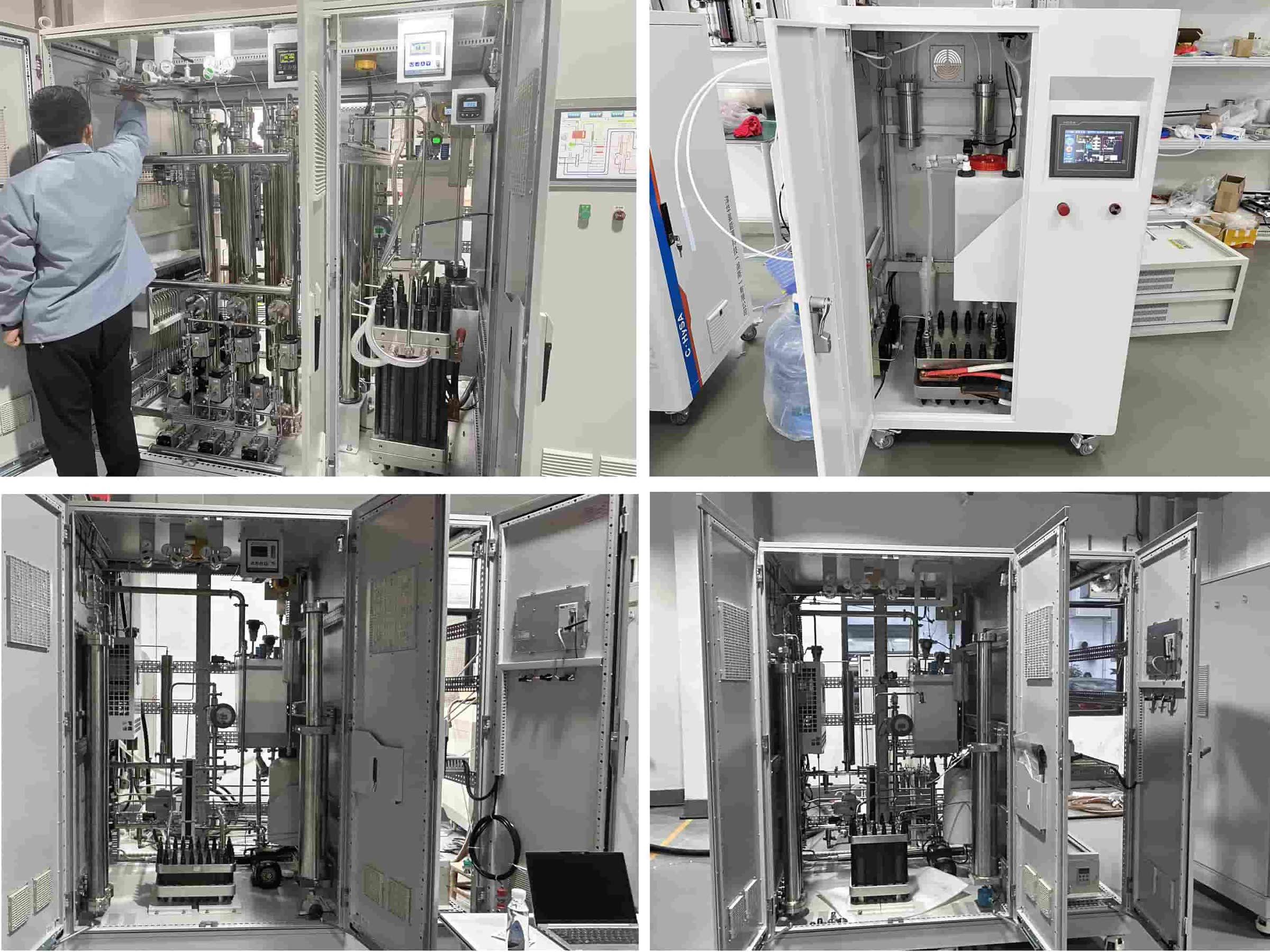

XUANCHENG, ANHUI, CHINA, November 26, 2026 /EINPresswire.com/ — Grid Instability Issues? Why Choose an Advanced Hydrogen Energy Storage System Manufacturer
Renewable energy now powers a growing share of electricity grids across Asia, Europe, and the Americas. Yet as wind and solar capacity expands, grid operators face a stability challenge that deepens rather than diminishes. Many project developers turn to an Advanced Hydrogen Energy Storage System Manufacturer for answers — and for good reason. The instability problem, however, runs deeper than most procurement conversations acknowledge. It operates simultaneously across four distinct time scales, each demanding a different technical response. Any storage strategy that addresses only some of those scales leaves the grid structurally exposed at the others.
The Time-Scale Ladder — Four Grid Problems, Not One
Grid instability does not arrive as a single phenomenon. Instead, it manifests as a stack of overlapping challenges. At the fastest level, frequency deviations occur within seconds when generation and load fall out of balance. Hours later, morning solar peaks and evening demand peaks create mismatches that require intra-day energy shifting. Beyond a single day, multi-day low-wind or low-irradiance periods generate surpluses followed by deficits — patterns that daily cycling systems cannot bridge. Finally, at the seasonal scale, summer solar abundance and winter wind output rarely align with heating or cooling demand. Each tier demands a storage technology suited to its specific duration and discharge profile. Together, these four tiers form what grid engineers increasingly call the time-scale ladder.
Where Battery Storage Hits a Physical Ceiling
Lithium-ion battery systems handle the bottom two tiers effectively. They respond quickly to frequency events. They shift energy across hours within a single day. Beyond that range, however, physical constraints intervene. Self-discharge accumulates over multi-day holding periods. Cycle degradation accelerates at extended depth-of-discharge. Calendar aging progresses regardless of cycling activity. These are not incremental engineering limitations awaiting a better chemistry iteration — they are intrinsic characteristics of the electrochemical system. Grid planners who treat battery storage as infinitely scalable across all four tiers routinely undersize long-duration capacity and overbuild short-duration infrastructure. The resulting grid remains exposed to Tier 3 and Tier 4 instability regardless of how much battery capacity it installs.
Hydrogen Bridges All Four Tiers Through a Three-Component Chain
Hydrogen energy storage addresses the full ladder through a coupled architecture of three distinct components. The electrolyzer converts surplus electrical energy into hydrogen during periods of excess renewable generation — absorbing wind and solar output that would otherwise face curtailment. The hydrogen storage system holds that energy in chemical form across any required duration, from hours to months, without meaningful self-discharge. The fuel cell reconverts stored hydrogen to electricity on demand, responding across any of the four time scales. Critically, the performance of this full chain depends not on individual component specifications but on how those three elements interact within an integrated system architecture. This is where engineering depth separates capable manufacturers from hardware assemblers.
Fast-Response and Mid-Range Capability — Where Integration Precision Matters Most
At the fastest tier, PEM electrolyzers deliver a load-following advantage. Their dynamic current response — adjustable within seconds — enables participation in primary frequency regulation services. Ramp rate and minimum turndown ratio determine how effectively a PEM system tracks grid frequency commands without destabilizing the electrolyzer stack. On the discharge side, fast-startup fuel cell systems — particularly air-cooled configurations designed for rapid response — contribute to frequency regulation from the storage side of the chain. Rubri, operating as a full-stack hydrogen energy manufacturer established in Hefei, China in 2011, produces both PEM electrolyzers across the 0.1 to 300 Nm3/h range and alkaline electrolyzers scaling from 1 to 1,000 Nm3/h. This dual-platform manufacturing capability matters at the Tier 1 and Tier 2 levels — different grid applications call for different electrolyzer characteristics, and a manufacturer limited to a single technology cannot optimally serve both. For Tier 2 and Tier 3 operations, hydrogen compressor modules bridge the pressure gap between electrolyzer output and storage vessel requirements. Rubri’s compressor range spans diaphragm, piston, gas-driven, and stationary configurations — reflecting recognition that compression management is a determinant of round-trip system efficiency, not a peripheral component decision.
Long-Duration Storage — The Architecture That Addresses Tiers 3 and 4
Seasonal and multi-week energy storage requires a fundamentally different storage philosophy. Stationary hydrogen storage systems — engineered for fixed installation and extended holding — provide the volumetric capacity that Tier 4 applications demand. Metal hydride hydrogen storage offers an alternative pathway: hydrogen bonds within solid metal alloys at lower pressures, delivering higher volumetric energy density compared to gaseous storage at equivalent pressure. This characteristic suits space-constrained installations or projects where high-pressure vessel management introduces operational complexity. Hefei Sinopower Technologies Co., Ltd. manufactures both stationary hydrogen storage modules and metal hydride hydrogen storage systems. That dual offering gives project developers a genuine choice of storage pathway based on site-specific requirements — rather than forcing acceptance of a single storage format irrespective of project context. This flexibility at the Tier 4 level distinguishes a systems-oriented manufacturer from one whose product scope ends at hydrogen production.
Safety Management and Grid Control — The Differentiator That Datasheets Rarely Capture
Advanced hydrogen energy storage systems operate within safety and control frameworks that extend well beyond component hardware. Hydrogen leak detection, pressure relief design, thermal management during charge and discharge cycles, and emergency shutdown protocols collectively define the operational safety envelope of any grid-connected hydrogen storage installation. Equally important, grid interaction control — the logic governing how a storage system responds to dispatch signals, manages state of charge across multiple time scales, and protects electrolyzer and fuel cell components from damaging operating excursions — determines whether a system genuinely delivers grid services or merely operates in isolation from grid needs. Rubri (Hefei Sinopower Technologies Co., Ltd.) extends its engineering scope into technical instruction services and R&D-backed support programs, alongside OEM and ODM customization capability. This scope indicates a manufacturer whose engineering responsibility does not end at the factory gate but continues through commissioning, optimization, and long-term system performance.
Selecting the Right Manufacturer — A Time-Scale Coverage Test
Grid developers evaluating hydrogen energy storage manufacturers gain clarity by applying a simple time-scale coverage test. Does the manufacturer supply PEM electrolyzers with documented ramp rate performance for Tier 1 participation? Does the compressor and stationary storage portfolio cover the pressure and capacity range needed for Tier 2 and Tier 3 operations? Does the manufacturer offer both gaseous and solid-state storage options for Tier 4 seasonal applications? Does the system scope include grid interaction control and safety management — or do those capabilities require separate engineering arrangements? Manufacturers who answer all four questions with verifiable product evidence demonstrate the integration depth that grid-scale hydrogen storage genuinely requires.
Conclusion — Grid Stability Demands Full-Spectrum Thinking
The grid stability challenge will not yield to single-tier solutions. Frequency regulation, daily peak management, multi-day curtailment absorption, and seasonal energy transfer each demand distinct technical capabilities — and all four operate simultaneously in any high-renewable grid. Hydrogen energy storage, engineered as a complete chain rather than assembled from disconnected components, addresses all four tiers in ways that battery storage physically cannot. Rubri continues to build its integrated hydrogen energy portfolio around this full-spectrum engineering philosophy, offering grid developers, utility operators, and renewable energy project teams a technically grounded manufacturing partner for long-duration storage challenges at any scale.
For technical consultation and product information, visit https://www.hfsinopower.com/.
Rubri
Rubri
email us here
Legal Disclaimer:
EIN Presswire provides this news content “as is” without warranty of any kind. We do not accept any responsibility or liability
for the accuracy, content, images, videos, licenses, completeness, legality, or reliability of the information contained in this
article. If you have any complaints or copyright issues related to this article, kindly contact the author above.

Media gallery