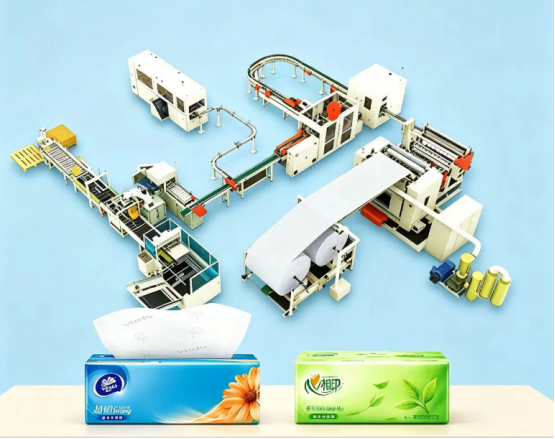

FOSHAN, GUANGDONG, CHINA, September 22, 2026 /EINPresswire.com/ — For manufacturers evaluating a China High-Quality Facial Tissue Machine Factory, the focus is increasingly shifting beyond basic production speed. Consistent processing, automated control, flexible product configurations, packaging integration, and efficient use of materials are becoming important considerations in modern tissue converting. Chuangxiang is developing its machinery around these requirements, with a focus on automated equipment for facial tissue and other paper-based sanitary products.
Automation in Modern Tissue Converting
The tissue converting industry is undergoing a gradual shift toward automated and integrated production. As manufacturers manage changing product specifications and increasingly complex packaging requirements, individual processing machines are being connected into complete production systems. Automation can reduce repetitive manual operations while improving consistency across folding, cutting, conveying, packaging, and material handling.
Chuangxiang works within this changing production environment by combining tissue processing equipment with automated control and packaging functions. Its machinery portfolio covers facial tissue, napkin paper, handkerchiefs, paper towels, and related tissue products, allowing different converting applications to be addressed through specialized equipment configurations.
For facial tissue production, the production process can begin with parent-roll feeding and continue through embossing, perforating, folding, conveying, individual packaging, case packing, and palletizing. Integrating these stages into a coordinated production line helps reduce unnecessary transfers between separate operations and creates a more continuous manufacturing process.
Facial Tissue Machinery Built Around Flexible Production
Facial tissue production involves several interconnected processes, and each stage can influence the consistency of the finished product. Folding accuracy, cutting performance, paper positioning, and packaging alignment all contribute to the final result.
Chuangxiang’s facial tissue production equipment incorporates automated control systems and servo-driven mechanisms to manage these operations. Servo control supports accurate folding movements, while photoelectric tracking assists with material positioning and process synchronization. Production counting and fault-diagnosis functions further support routine operation and production monitoring.
Different tissue products can also require different dimensions, layers, folding formats, and packaging arrangements. Chuangxiang addresses this variation through configurable equipment and modular production-line structures. Depending on the manufacturing requirement, equipment can be arranged around selected processing stages or developed as a more integrated line covering production and packaging.
This flexibility is particularly relevant to tissue manufacturers that need to accommodate several product formats within the same manufacturing environment.
Precision and Control in Paper Processing
Paper converting requires a balance between mechanical movement and electronic control. Tissue materials are lightweight and relatively delicate, making stable feeding and accurate positioning important throughout the production process.
Chuangxiang combines mechanical processing with PLC-based control and automated monitoring functions. Such systems help coordinate machine movements and allow operating parameters to be managed more consistently. Servo systems, photoelectric sensors, and automatic counting contribute to repeatable production while reducing reliance on manual intervention.
The same principle extends to folding equipment. Facial tissue machines can be configured for different folding requirements, while optional embossing and perforating functions provide additional processing possibilities. These features allow manufacturers to adjust production according to the characteristics of the tissue product rather than relying on a single fixed operating format.
Applications Across Multiple Tissue Categories
Although facial tissue is a major application, Chuangxiang’s machinery extends into several other tissue-converting categories. Napkins, handkerchiefs, kitchen towels, and pocket tissues require different combinations of folding, cutting, embossing, printing, and packaging processes.
Kitchen towel production, for example, can involve interfolding jumbo rolls and additional processes such as embossing or glue lamination. Depending on the product configuration, printing and other processing functions can also be incorporated into the production system.
Napkin production presents another set of requirements, particularly around folding formats, material handling, and packaging. Chuangxiang’s equipment portfolio addresses these different applications through machinery designed for specific converting processes rather than treating tissue production as a single standardized operation.
This broader application range also allows production-line concepts to be adapted to different paper products and manufacturing requirements.
Resource Efficiency and Equipment Development
Energy consumption, material utilization, and production waste have become increasingly relevant to tissue manufacturers. Rising attention to resource efficiency is encouraging equipment developers to consider not only production capacity but also how machines operate throughout the converting process.
Chuangxiang incorporates energy-efficient operation and waste-reduction considerations into its machinery design. Low-noise operation is also relevant in production environments where equipment may operate continuously for extended periods.
Resource efficiency, however, depends on the complete production system. Raw material characteristics, product specifications, machine settings, operating conditions, and maintenance practices can all influence actual consumption and waste levels. Equipment design therefore needs to support manufacturers in optimizing the wider process rather than relying on a single efficiency feature.
Engineering and Customization for Different Production Needs
A tissue production line has to correspond with the manufacturer’s product specifications, raw materials, factory arrangement, and packaging requirements. A standard machine configuration may not always provide the most suitable production arrangement.
Chuangxiang combines equipment manufacturing with engineering customization, allowing production systems to be configured around different tissue formats and processing requirements. Modular equipment structures provide room for different combinations of production and packaging functions, while automated control systems coordinate the individual stages.
Technical support also forms part of the equipment lifecycle. Installation, troubleshooting, spare-parts availability, maintenance, and adjustments can influence the long-term operation of converting machinery. Chuangxiang provides technical and after-sales services alongside its equipment, creating a more complete support structure for manufacturers operating automated tissue production systems.
Supporting International Tissue Production
Tissue products serve everyday consumer and commercial applications across a wide range of markets, creating demand for machinery capable of handling different production conditions and product specifications. Chuangxiang has developed an export-oriented machinery business serving markets across Asia, Africa, the Middle East, and Europe.
International applications also place greater importance on adaptable engineering. Production environments can differ in factory layout, product preferences, packaging formats, available technical resources, and operating requirements. Configurable machinery and technical support can therefore play an important role when production systems are introduced into different markets.
Rather than focusing on one type of tissue product, Chuangxiang has developed equipment covering several converting categories. This approach provides a broader technical base for manufacturers that may need to produce multiple paper-based sanitary products.
The Direction of Tissue Converting
The development of tissue machinery is increasingly connected with automation, flexibility, process integration, and resource management. Manufacturers are looking for systems that can maintain stable production while adapting to changing product specifications and packaging requirements.
Chuangxiang’s focus on automated tissue production and packaging reflects these broader changes. Facial tissue production lines, folding machines, paper towel equipment, napkin machinery, and related packaging systems form part of an equipment portfolio designed around different stages of paper converting.
As production requirements continue to evolve, machinery will need to combine precise mechanical processing with adaptable control systems and practical line integration. For tissue manufacturers, the value of automation lies not simply in replacing manual operations but in creating a more coordinated production process that can maintain consistency across multiple stages.
Chuangxiang continues to develop its role in this area through facial tissue and tissue-converting machinery, combining automated processing, configurable production lines, engineering support, and applications across several paper-based sanitary product categories.
More information about Chuangxiang’s facial tissue machines, tissue production lines, packaging equipment, and related paper-converting solutions is available at https://www.cx-tissuemachine.com/.
Foshan Chuangxiang Automation Equipment Co., Ltd.
Foshan Chuangxiang Automation Equipment Co., Ltd.
email us here
Legal Disclaimer:
EIN Presswire provides this news content “as is” without warranty of any kind. We do not accept any responsibility or liability
for the accuracy, content, images, videos, licenses, completeness, legality, or reliability of the information contained in this
article. If you have any complaints or copyright issues related to this article, kindly contact the author above.

Media gallery