

Austin, Texas – October 5, 2026 –

Photo by Simpson33 from Getty Images.
Search is becoming more complicated for health brands.
Yes, ranking on Google still matters, but telehealth and telemedicine companies also need to consider how their brands appear in AI search, how much authority their websites carry, whether technical issues are holding important pages back, and which searches can actually generate revenue.
DTC SEO Agency is already working across several high-competition health niches. Its health-sector experience spans different types of businesses, including telehealth and online pharmacy brands, research peptide companies, dog health websites, and other businesses operating in competitive health-related search markets.
That range matters because the same challenge keeps coming up: these brands rarely compete in easy search results. They often face established publishers, major health platforms, pharmacies, marketplaces, and other businesses that have spent years building authority.
DTC SEO Agency’s approach focuses on closing that gap while keeping the emphasis on commercial outcomes.
Why Telehealth Is a Natural Fit for DTC SEO Agency
DTC SEO Agency’s approach starts with commercial intent. Rather than making blog traffic the main objective, the team prioritizes searches closer to purchase or conversion. In some campaigns, commercial and transactional terms account for around 80% of the strategy.
That is particularly relevant to telehealth.
Someone searching for treatment prices, comparing providers, researching a medication, or looking for a specific treatment online may be much closer to taking action than someone reading a broad health article.
Co-founder Thomas Phillips has repeatedly argued that search volume alone does not determine whether a keyword is worth pursuing. A lower-volume query with clear buying intent may be far more valuable than a larger informational term that produces little revenue.
The agency’stelehealth SEO service applies that thinking to health brands, combining technical SEO, commercially focused content, authority building, and search visibility around high-intent queries.
Thomas Phillips Brings First-Hand Telehealth SEO Experience
DTC SEO Agency’s approach to telehealth is shaped by Thomas Phillips’ long track record in organic search and e-commerce.
In a recent breakdown of telehealth SEO, Phillips introduces the agency’s experience directly, noting:
“We’ve been doing SEO for almost 20 years at this point…exited 17 different brands that we’ve built internally, all from SEO.”
He also explains that the agency studies large telehealth businesses to understand exactly why their organic visibility has grown and how those same principles can be applied to client campaigns.
A major part of that is authority.
Phillips points to Domain Rating, referring domains, high-quality content, and links from major publications as some of the signals behind the strongest telehealth sites. As he explains, the goal is not simply to publish more pages, but to build enough authority that Google starts to trust the brand as a serious source in its category.
That experience also shapes how the agency allocates SEO budget. Rather than chasing the broadest possible traffic, DTC SEO Agency emphasizes commercial and transactional searches, where the potential return is clearer.
Phillips explains:
“We want the highest ROI with the lowest spend and the lowest budget possible.”
A UK Online Pharmacy Shows What This Looks Like in Practice
One of DTC SEO Agency’s clearest health-sector case studies comes from an established UK online pharmacy competing in prescription weight-loss treatments.
The search environment was extremely competitive. When the engagement began, the client had an Ahrefs Domain Rating of 21 and was competing against national pharmacy chains and well-funded telehealth platforms, some with Domain Ratings above 80.
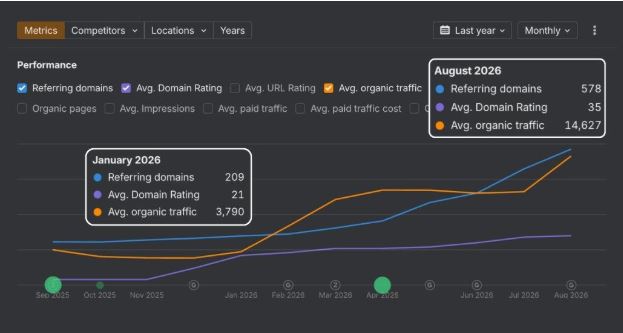
Figure: Organic traffic growth, January to August 2026. (Source: Ahrefs)
The website was receiving an estimated 3,790 monthly organic visits in the UK. Important Mounjaro-related terms were sitting between positions 60 and 98.
Eight months later:
-
Estimated monthly organic traffic had increased to 14,626, a rise of 286%.
-
Keywords ranking in positions one to three increased from 111 to 357.
-
Referring domains increased from 209 to 579.
-
Domain Rating increased from 21 to 35.
-
The Mounjaro keyword cluster grew from no estimated organic traffic to 3,092 monthly visits.
-
Seven Mounjaro-related keywords reached the top three.
The campaign combined technical SEO, content creation, link building, Digital PR, and strategic consulting. This is a useful example because the gains did not come from one tactic. The site first needed technical problems fixed. It then needed stronger commercial pages, better content targeting, more authority, and relevant backlinks.
Technical SEO Matters More in Competitive Health Search
Health sites can lose visibility because of problems that have little to do with the quality of the product itself.
In the pharmacy campaign, DTC SEO Agency found 161 pages without dependable crawlable H1 headings, duplicate URL variations, broken pharmacy URLs, cannibalization issues, and other structural problems.
Those issues matter because search engines need a clear understanding of which pages should rank and what each page is about.
The agency’s view is that technical SEO rarely creates rankings on its own. Instead, it removes the barriers that prevent content and backlinks from having their full effect. In the pharmacy case study, the agency described technical SEO as removing the “ceiling” so later work could deliver stronger results.
For telehealth brands, where authority and trust are already difficult to earn, wasting existing ranking signals through poor technical structure is particularly costly.
SEO and AI Search Are Part of the Same Strategy
DTC SEO Agency does not treat AI search as a replacement for traditional SEO. Thomas Phillips argues that the foundations increasingly overlap.
AI assistants and generative search tools often draw information from authoritative sources across the web. That means strong content, credible mentions, quality backlinks, and visibility in respected publications can help both conventional rankings and AI citations.
As Phillips puts it, the work that builds SEO authority now “bleeds over into SEO, LLM, GEO, AEO, whatever the hell you want to call it at this point.”
He is also cautious about brands abandoning SEO to focus only on generative search.
In one example, Phillips described a client generating more than $32 million in revenue from organic search while AI-search revenue was around $19,000, despite strong citation visibility. His point was not that AI search is unimportant. It was that brands should build for both channels rather than sacrifice a mature revenue source for an emerging one.
DTC SEO Agency supports that approach with a custom Triple Whale-integrated dashboard designed to track both organic and AI search performance.
What Clients Value Beyond Rankings
The agency’s broader client feedback also points to something that matters in complex telehealth campaigns: execution.
Trustpilot reviews have praised the team for communication, reliability, organization, and clear deliverables. One client said the agency helped improve organic rankings significantly over roughly a year, while another reported reaching positions one to three for keywords they had previously considered out of reach within the first three months.
Those reviews reinforce the operating style behind the agency’s more specialized health work: clear expectations, defined deliverables, and ongoing attention to the site rather than isolated SEO tasks.
What This Means for Telehealth Brands
Telehealth businesses need more than a few optimized service pages. They are competing in search environments where technical quality, authority, content, backlinks, commercial relevance, and brand credibility all affect visibility.
DTC SEO Agency’s experience across telehealth, online pharmacy, research peptides, pet health, and other health-related sites gives the team a broader understanding of how these challenges play out across the sector.
The search terms may change, but the commercial objective stays the same: build enough authority to compete, rank the pages closest to conversion, remove technical barriers, and measure whether search is actually contributing to revenue.
That is where DTC SEO Agency’s specialization becomes most relevant. The agency applies an e-commerce, revenue-first model to health brands that need to compete in difficult search results across both Google and AI platforms.
Final Thoughts
DTC SEO Agency is already building a distinct position in telehealth, telemedicine, and health-focused SEO.
Its work combines technical SEO, commercial keyword targeting, authority building, Digital PR, and AI search with a clear focus on revenue. The UK online pharmacy case study shows what that approach looks like in practice, with major gains in organic traffic, top-three rankings, and visibility for valuable treatment-related searches.
As search continues to shift across Google and AI platforms, that mix of technical depth, commercial intent, and health-sector experience gives the agency a strong foundation for working with telehealth brands in increasingly competitive markets.
About DTC SEO Agency
DTC SEO Agency is a specialist search marketing firm founded in 2023 in Austin, Texas by Thomas and Olivia Phillips, focused on helping direct-to-consumer and e-commerce brands grow through organic search. The agency works with 7, 8 and 9-figure eCommerce brands and centers its approach on ROSI – Return on SEO Investment, prioritizing measurable impact over vanity metrics like traffic or rankings alone.
Media Contact
Company Name: DTC SEO Agency
Contact Person: Thomas Phillips
Email: Send Email
Country: United States
Website: https://www.dtcseoagency.com/seo-for-health/telehealth
Press Release Distributed by ABNewswire.com
To view the original version on ABNewswire visit: How DTC SEO Agency Is Specializing in Telehealth, Telemeds, and SEO & AI Search
