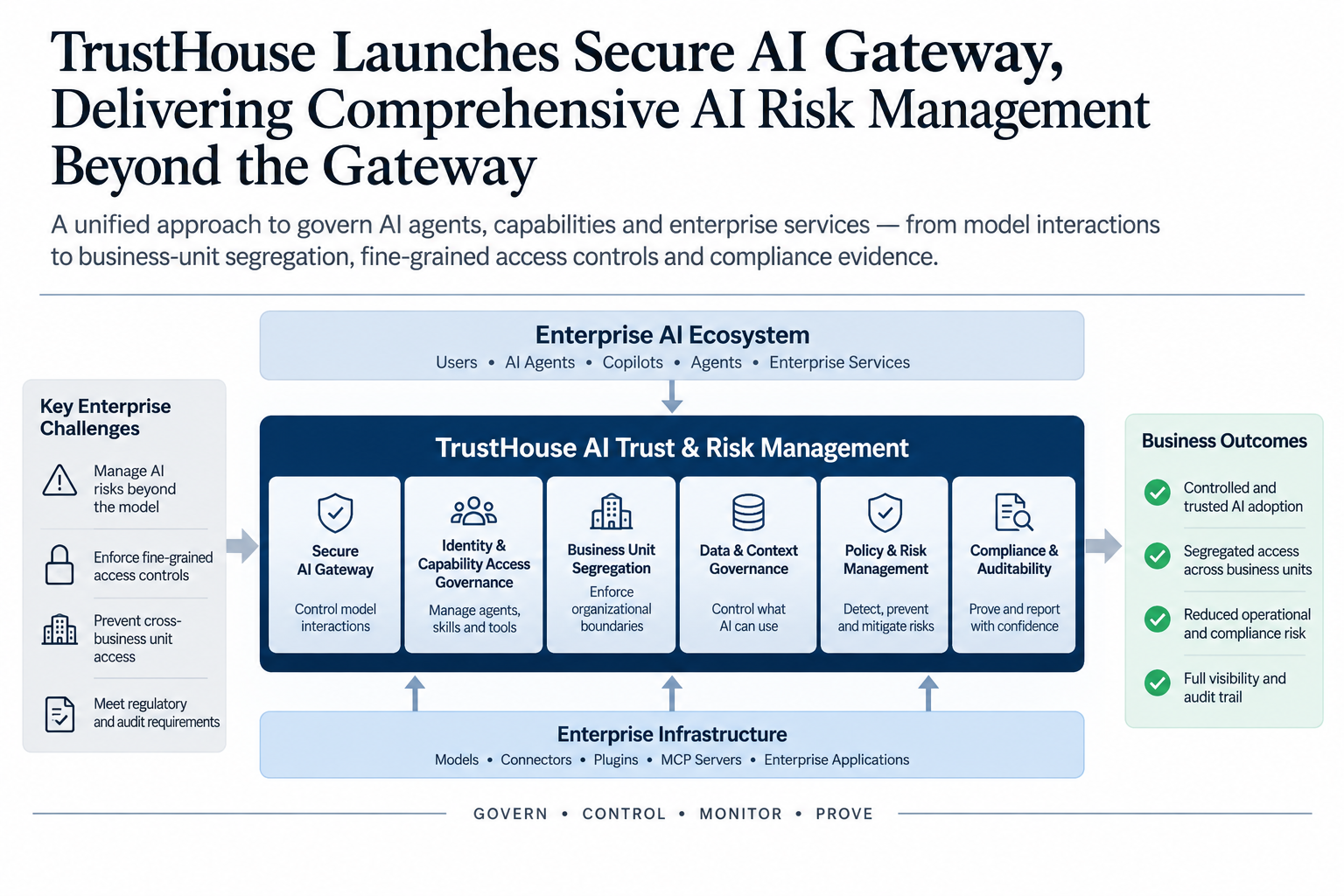

New governance capabilities address AI identities, fine-grained access controls, business-unit segregation, runtime policy enforcement and auditability.
FRISCO, TX, UNITED STATES, November 20, 2026 /EINPresswire.com/ — TrustHouse today announced the launch of its Secure AI Gateway as part of a broader enterprise AI risk management approach designed to address security and governance challenges that extend beyond traditional AI gateway capabilities.
As organizations move from conversational AI to autonomous and semi-autonomous AI agents, the scope of enterprise risk is expanding. AI systems increasingly interact with business applications, databases, enterprise services, external connectors, plugins, skills and Model Context Protocol (MCP) servers. Controlling access to AI models alone does not address the broader risks associated with what AI agents can access, which actions they can perform, and how those activities are governed across an organization.
TrustHouse addresses this broader governance challenge by treating the AI gateway as one component of an integrated AI trust and risk management architecture.
### Extending Governance Beyond AI Model Interactions
Traditional AI gateways primarily focus on managing model interactions, including request routing, authentication, prompt and response inspection, and traffic controls. While these capabilities remain important, enterprise AI deployments introduce additional governance requirements involving agent behavior, organizational permissions, service access and operational accountability.
The TrustHouse approach extends governance across several interconnected areas:
AI Identity and Capability Access Governance: Provides a governance framework for controlling which AI agents can discover and invoke approved skills, plugins, connectors, MCP servers and enterprise tools. Access policies can be structured around agent identity, delegated user permissions, specific actions and authorized resources.
Business Unit and Service Segregation: Addresses organizational access boundaries by enabling policies that distinguish between business units, their services, agents and associated resources. Cross-business-unit access can be governed through explicit authorization requirements rather than implicitly inherited permissions.
Context-Aware Policy Enforcement: Evaluates access and requested actions against applicable organizational policies and contextual authorization requirements. This extends beyond determining whether a user or agent is authenticated to considering whether a particular action is authorized in its business context.
Data and Context Governance: Supports governance of information used by AI systems, including data access, context, provenance and traceability. This helps organizations establish greater visibility into the information supporting AI interactions and decisions.
Runtime Risk Management and Auditability: Extends policy controls to AI-driven activities and tool interactions, with an emphasis on identifying policy violations, recording authorization decisions and maintaining evidence of AI activity for review and accountability.
### Addressing the Changing Enterprise AI Security Boundary
A key consideration in enterprise AI governance is that shared AI infrastructure does not necessarily imply shared business permissions.
For example, a finance agent and an HR agent may operate using the same AI infrastructure while requiring completely separate access to financial systems, payroll services, employee records and business applications. Similarly, an authorized agent should not automatically inherit unrestricted access to every capability exposed through an enterprise connector or MCP server.
TrustHouse’s broader governance approach addresses these organizational and operational boundaries through policy-driven access controls and governance across AI agents and the enterprise services they interact with.
“Enterprise AI security cannot stop at the model endpoint. Organizations need visibility and control over the identities, permissions, business context, tools and services that AI systems use to perform work. The gateway is an important enforcement component, but governing the broader AI operating environment is essential,” said Chiru Bhavansikar, Chief AI Officer, TrustHouse.AI
### Supporting Enterprise AI Governance
TrustHouse’s approach is intended to complement existing enterprise identity providers, security controls, AI infrastructure and model gateways rather than require organizations to replace their existing AI investments.
The objective is to help enterprises establish a governed operating environment for AI adoption, with consistent controls spanning model interactions, agent capabilities, organizational boundaries, enterprise services and operational evidence.
The approach is designed to support enterprise security and compliance programs. It does not replace an organization’s regulatory obligations, compliance assessments, security teams or independent audits.
For more information, visit https://trusthouse.ai.
### About TrustHouse.AI
TrustHouse.AI is an AI Trust and Context Infrastructure built on Integrity-First AI principles and evolved from Arhasi’s R.A.P.I.D. framework. Combining contextual intelligence, governance, security, provenance, and deterministic execution controls, TrustHouse.AI helps enterprises establish the foundations for reliable and accountable AI operations. Its mission is to enable organizations to move beyond AI experimentation toward trusted enterprise intelligence, where context informs decisions, integrity governs actions, and outcomes can be validated and traced.
Chiru Bhavansikar
TrustHouse.AI (dba Arhasi Inc)
+1 214-302-7147
Visit us on social media:
LinkedIn
YouTube
Legal Disclaimer:
EIN Presswire provides this news content “as is” without warranty of any kind. We do not accept any responsibility or liability
for the accuracy, content, images, videos, licenses, completeness, legality, or reliability of the information contained in this
article. If you have any complaints or copyright issues related to this article, kindly contact the author above.

Media gallery